
How to Do a Wall Sit: Form, Depth, and How Long to Hold
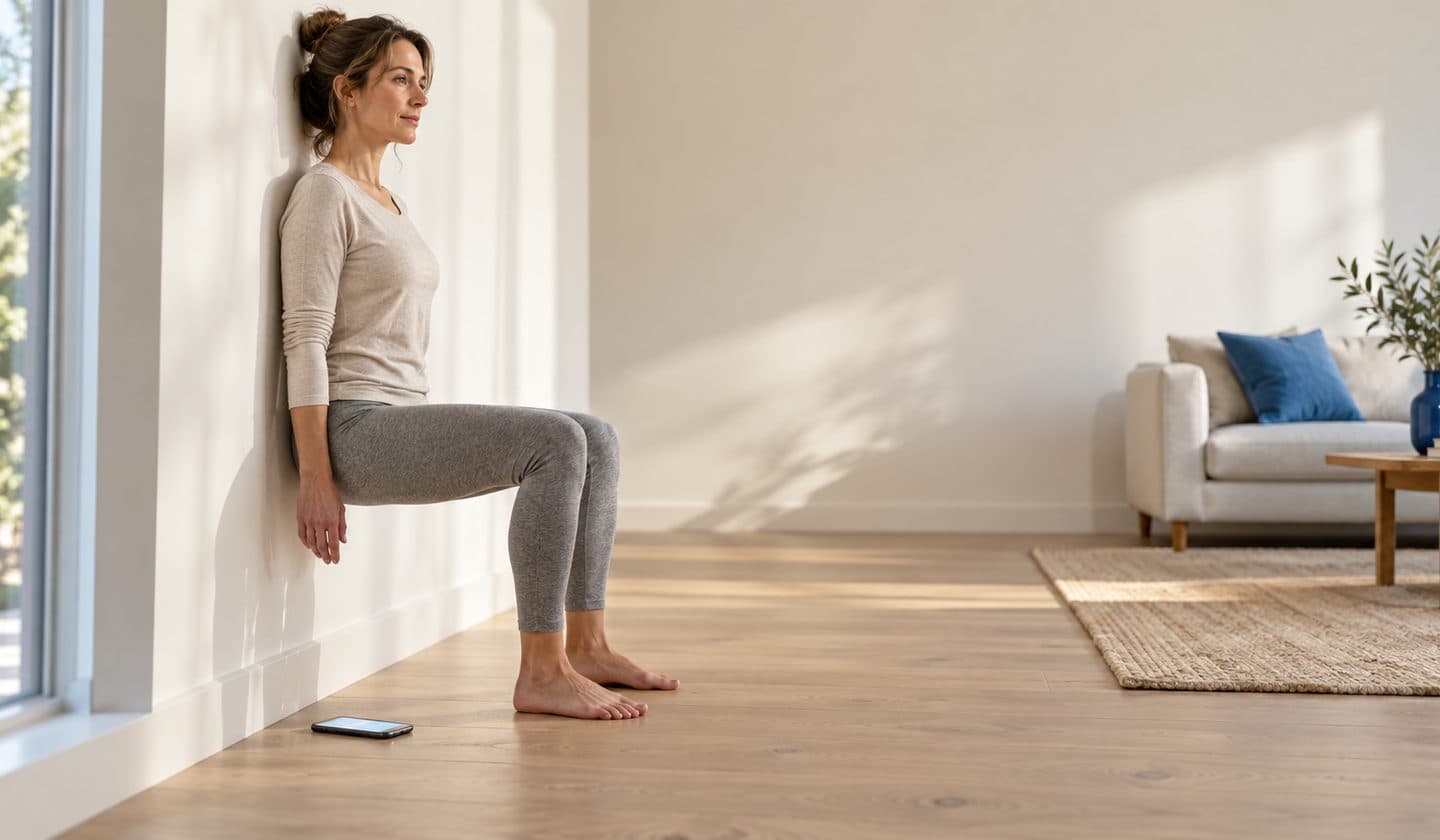
To do a wall sit, stand with your back flat against a wall, walk your feet out about two foot-lengths to start, then slide down until your knees are bent and your shins are roughly vertical. Hold there, breathing normally, until your form starts to go. A useful first target is 30 to 60 seconds at a depth you can manage, and the depth is the part most guides get wrong, so it comes first below.
Three things to get right:
- Start about two foot-lengths from the wall, then adjust your feet until your shins are roughly vertical.
- Depth is adjustable. Shallower is easier and deeper is harder, and in the research heart rate and blood pressure rose steadily as knee angle decreased [1].
- Breathe normally the whole way through. If you are holding your breath, come up.
How do you do a wall sit?
Six steps, and the whole thing takes about fifteen seconds to set up.
- Find a clear stretch of smooth wall. No skirting board or radiator behind your back.
- Stand with your back against it, feet roughly shoulder-width apart.
- Walk your feet forward about two foot-lengths to start, keeping your back on the wall.
- Slide down until your thighs are angled toward parallel with the floor, then adjust your feet until your shins are roughly vertical and your knees are above your ankles.
- Press your whole back into the wall, let your arms hang or rest lightly on your thighs, and look straight ahead.
- Start the timer and breathe normally. Stand up when your back peels off the wall or your knees start drifting inward.
If your heels want to lift, your feet are too close to the wall. Walk them out another few centimetres and try again.
How deep should your knees be in a wall sit?
As deep as you can hold with a flat back, and no deeper. Ninety degrees is the version everyone pictures, but it is the hardest end of a range.
In a study of 23 adults, each person held a two-minute wall squat at ten different knee angles, from 135 degrees down to 90 degrees in 5-degree steps, while the researchers measured heart rate and blood pressure [1]. Heart rate and blood pressure rose steadily as the knee angle decreased. Average heart rate was 76 beats per minute at 135 degrees and 119 at 90 degrees.
So your knee angle is a volume knob. A beginner who cannot hold 90 degrees for twenty seconds is sitting too deep, and has not failed at wall sits. Come up ten or fifteen degrees and hold that properly instead.
How long should you hold a wall sit?
Thirty to sixty seconds with a flat back is a useful working target for most people. Blood-pressure trials use two-minute holds [2].
- New to it: 20 to 30 seconds at a shallow angle, two or three times, with a minute between.
- Building endurance: 45 to 60 seconds, three times, at a depth that feels hard by the end.
- Research protocol: blood-pressure trials commonly use four two-minute holds with one to four minutes of rest, three times a week, with the wall-sit depth adjusted to the individual [2].
The first two are working targets, so let your own retest tell you where you are.
What is a good wall sit time?
There isn’t an established one. Unlike the plank, which has the datasets we went through in our post on average plank time by age, the wall sit has no large reference dataset, so the by-age charts and “good time” figures circulating online are conventions repeated between fitness sites rather than measured norms.
The nearest thing to a yardstick is the research protocol itself: trial participants held two minutes, four times, at an intensity set for them [2]. Four two-minute holds is therefore a useful research reference point, although the studies typically adjusted wall-sit depth to the individual rather than requiring a 90-degree position.
One figure is worth flagging because it is quoted so widely. Several sites report that women hold a wall sit longer than men, 72.9 seconds against 46. That number comes from a 2024 student conference abstract in which five men and five women aged 19 to 25 were timed holding a wall sit [4]. It is real, published work, but ten young adults is not a population norm and it shouldn’t be repeated as one.
The comparison that means something is your own. Time one sit today, train for four weeks, time it again.
What does the research say about wall sits and blood pressure?
This is why the wall sit keeps turning up in the health press. A 2026 meta-analysis of 40 randomised trials [3] reported average reductions of 6.62 mmHg systolic and 2.63 mmHg diastolic in resting blood pressure across isometric training. Exploratory subgroup analyses found larger reductions in trials that used wall squats three times a week for more than eight weeks, although the authors’ meta-regression did not find duration or frequency to be significant moderators. A 2024 review of the field [2] describes the standard protocol: four two-minute holds, one to four minutes of rest between them, three times a week, with intensity set for each individual.
Those are average findings in trial populations, not a forecast for any one person. Our guide to isometric exercise and blood pressure goes through the evidence, including what it does not show.
Blood pressure also rises temporarily while you hold a wall sit, particularly at deeper angles [1], even though trials have reported lower resting blood pressure after weeks of training. If you have cardiovascular disease or uncontrolled high blood pressure, get medical advice before using wall sits specifically as blood-pressure training.
Common wall sit mistakes
- Feet too close to the wall, so your shins slope and your heels want to lift.
- Lower back arching off the wall, which quietly takes the work off your legs.
- Knees falling inward as you tire. Think about pushing them gently apart.
- Hands pressed hard into your thighs, taking weight your legs are supposed to be holding.
- Holding your breath to get through the last ten seconds. Come up instead.
- Going straight to 90 degrees on day one because that is what the picture looked like.
A four-week wall sit progression
There is no well-established four-week progression for improving your maximum wall-sit time. This is a practical Just Hold progression to try, with percentages that are our own and not from a trial. Test, train below your maximum, retest. Sit at the same angle every session so the times compare, pick an angle you can hold for at least twenty seconds on day one, rest one to two minutes between holds, and take a day off between sessions.
- Day 1: one wall sit to your limit at a fixed angle. Write the number down.
- Week 1: three sessions of three holds at 60 per cent of that time.
- Week 2: three sessions of three holds at 70 per cent.
- Week 3: three sessions of four holds at 85 per cent. This is the hard week, so stop early if your form goes.
- Week 4: two easier sessions of two holds at 60 per cent, with at least a day between them. Rest for a day or two, then retest.
If the retest is comfortably up, the next block goes deeper rather than longer. Drop your knee angle by about ten degrees, test again at the new depth, and run the four weeks from that number.
Frequently asked questions
Is a wall sit the same as a wall squat?
Yes. The two names describe the same hold, and the research papers generally use “isometric wall squat”. Just Hold calls it a wall squat in the app and a wall sit in most of the writing, because that is what people search for.
Should your knees be exactly at 90 degrees?
No. Ninety degrees is the hardest common depth. The wall squat study above ran from 135 degrees down to 90 and found a steady relationship across the whole range [1], so any angle you can hold with a flat back is a real wall sit.
How often should you do wall sits?
Three sessions a week, with a day off between, is the frequency used in most of the training trials [2], and it is what the first three weeks of the four-week block above use.
Do wall sits hurt your knees?
A wall sit shouldn’t hurt. Check that your knees aren’t collapsing inward, try a shallower position, and stop if the movement causes pain. If you have an existing knee problem, speak to your clinician before starting wall sits.
Can you do a wall sit without a wall?
You can hold the same position unsupported, but it is a different exercise and a much harder one, because your back and hips are then doing the work the wall was doing. A smooth door, a fridge or a flat cupboard side all work fine as substitutes.
The bottom line
A wall sit is one of the easiest exercises to start and one of the easiest to do badly. Set your feet far enough forward, keep your back flat, and choose a depth you can hold.
- Start two foot-lengths from the wall, then adjust until your shins are roughly vertical
- Any knee angle you can hold with a flat back
- 30 to 60 seconds to start, two-minute holds in the blood-pressure trials
- Three times a week, and stop when your form goes
The hard part is not the hold, it is doing it again on Thursday, which is where Just Hold helps: every time written down and somebody to beat.
This page is for educational purposes only and is not medical advice. If you have health concerns or are unsure whether to start exercising, consult your doctor first.
- Goldring N, Wiles JD, Coleman D. The effects of isometric wall squat exercise on heart rate and blood pressure in a normotensive population. Journal of Sports Sciences. 2014;32(2):129–136.
- Edwards JJ, Coleman DA, Ritti-Dias RM, et al. Isometric Exercise Training and Arterial Hypertension: An Updated Review. Sports Medicine. 2024;54(6):1459–1497.
- Yan Y, Sun C, Pan L, Ma H, Xie H. Effects of isometric training based on the entire population on blood pressure regulation: systematic review and meta-analysis of randomized controlled trials. Frontiers in Public Health. 2026;14:1774541. Figures quoted are the corrected values from the journal’s 2026 correction notice.
- Martin T, Mullin K, Davis D, Esquivel B, Gomez A. Wall Sit Endurance Between Males and Females. International Journal of Exercise Science: Conference Proceedings. 2024;17(3):Article 2.