
Micro-Dosing Wall Squats: Can “Isometric Snacks” Undo Sitting Damage?
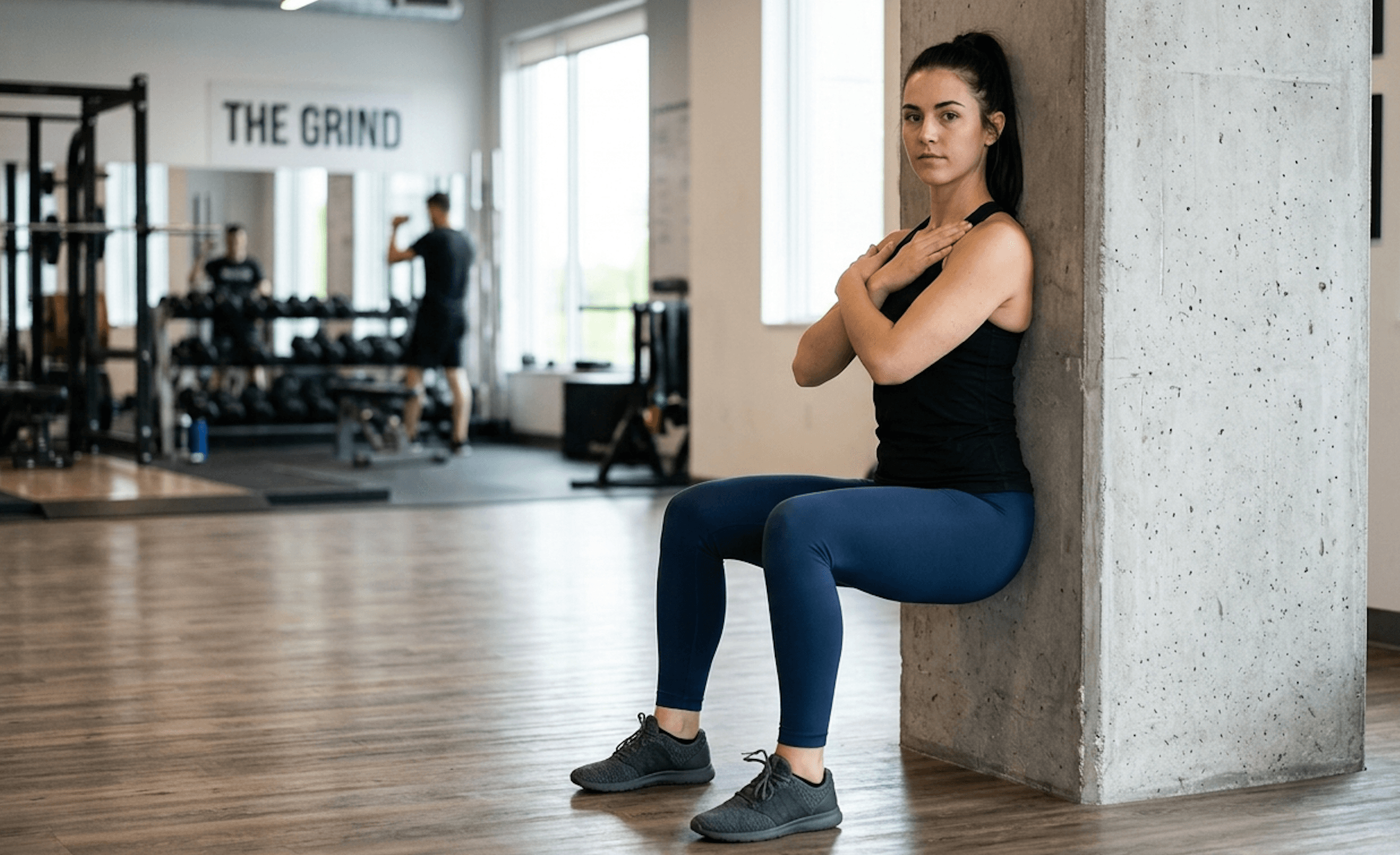
An isometric snack is a brief, deliberate strength dose (typically 1–2 minutes of hard wall-squat holds, repeated 2–4 times) taken during a normal workday. The case for this format rests on a 2023 BJSM network meta-analysis of 270 trials [2] showing isometric training produced the biggest resting-blood-pressure reductions of any modality tested, with wall squats among the two best-performing submodes. This post covers what the evidence actually supports, what it doesn’t, and a realistic weekday protocol.
What is an isometric snack?
A brief, low-friction strength dose that you can do during a normal workday. For wall squats:
- 1–2 minutes per hold
- 2–4 holds per session
- Short rests between (1–2 minutes)
- A knee angle where the last 15 seconds are genuinely hard
That’s it. No gym. No setup. Just a wall and a timer. When you want the holds to count, you can time your wall sits in Just Hold and see how your friends are getting on.
Why interrupting a sitting day matters
Prolonged uninterrupted sitting is independently associated with worse cardiometabolic markers, even in people who otherwise exercise regularly. A 2016 harmonised meta-analysis in The Lancet pooled more than a million adults and found that high sitting time was associated with increased mortality, though the association was largely attenuated in people meeting 60–75 minutes of moderate activity per day [1].
The practical read: if you can’t break up sitting with walking, breaking it up with brief, effortful work is a reasonable substitute — and arguably a more efficient one for certain outcomes.
What the evidence says about wall squats specifically
A 2023 network meta-analysis in the British Journal of Sports Medicine looked at 270 randomised trials of exercise training and resting blood pressure. Across every category of exercise, isometric training produced the largest reductions. Wall squats were one of the two best-performing submodes [2].
The protocols that delivered those effects were structured — typically four sets of two minutes, at a knee angle where the final seconds are difficult, three times a week, sustained over 8–12 weeks. That’s real effort though, not “pretend to hold a wall sit while checking email.”
Where the research stops
The evidence is clearest on resting blood pressure. It’s less clear-cut on things like offsetting long sitting blocks, on glucose regulation, on “undoing” anything. Those outcomes need their own evidence, and the studies are either smaller, mixed, or still emerging.
Wall-squat snacks can meaningfully improve an important risk marker. They are not a free pass for 10+ hours of daily inactivity. Both things can be true, so make sure you fold in other fitness elements.
How to micro-dose wall squats properly
Form first
- Back flat against the wall
- Knees tracking over feet
- Controlled depth, not always maximal
- Calm breathing, never breath-holding
If your knees are irritated, reduce depth and time and progress when comfort is consistent.
A realistic starter protocol
- 3 days per week
- 3 sets × 45–90 seconds
- 1–2 minutes rest between sets
- Knee angle chosen so the last 15 seconds feel hard
When that’s stable for two weeks, extend toward 2-minute sets or add a fourth set.
A desk-day template
Two small sessions during a working day is achievable:
- Mid-morning: 2 × 60 seconds
- Mid-afternoon: 2 × 60 seconds
Four minutes of actual work time. A small dose that adds up.
Common mistakes
Going too deep too soon. Creates knee stress without benefit. Start at a knee angle well above 90 degrees and progress.
Holding breath. Raises perceived effort and blood pressure during the set. Breathe normally throughout.
Treating it like a one-week challenge. Repeatability beats intensity. A small dose you do three times a week for three months will beat a hard week followed by two weeks off. Keep showing up.
Expecting one metric to change overnight. Resting BP changes are measured over weeks, and months not days. Track a running average over a fortnight, not any single morning reading.
If adherence is rising and comfort is fine, you’re winning. If knee comfort drops, reduce depth before reducing frequency.
The bottom line
Can isometric snacks “undo” sitting damage on their own? No.
Can micro-dosed wall squats meaningfully improve real health markers, slot into a desk-heavy day without needing a gym, and be sustainable over months? Yes, and that’s a strong case for them, especially when a more ambitious plan isn’t realistic.
The best program is the one you’ll actually do. Wall-squat snacks score highly on that test.
Educational content only, not medical advice. Adjust based on your pain history and your clinician’s guidance where relevant.
References
- [1] Ekelund U, Steene-Johannessen J, Brown WJ, et al. Does physical activity attenuate, or even eliminate, the detrimental association of sitting time with mortality? A harmonised meta-analysis of data from more than 1 million men and women. The Lancet. 2016;388(10051):1302–1310.
- [2] Edwards JJ, Deenmamode AHP, Griffiths M, et al. Exercise training and resting blood pressure: a large-scale pairwise and network meta-analysis of randomised controlled trials. British Journal of Sports Medicine. 2023;57(20):1317–1326.