
Why Dead Hangs Deserve a Minute of Your Day
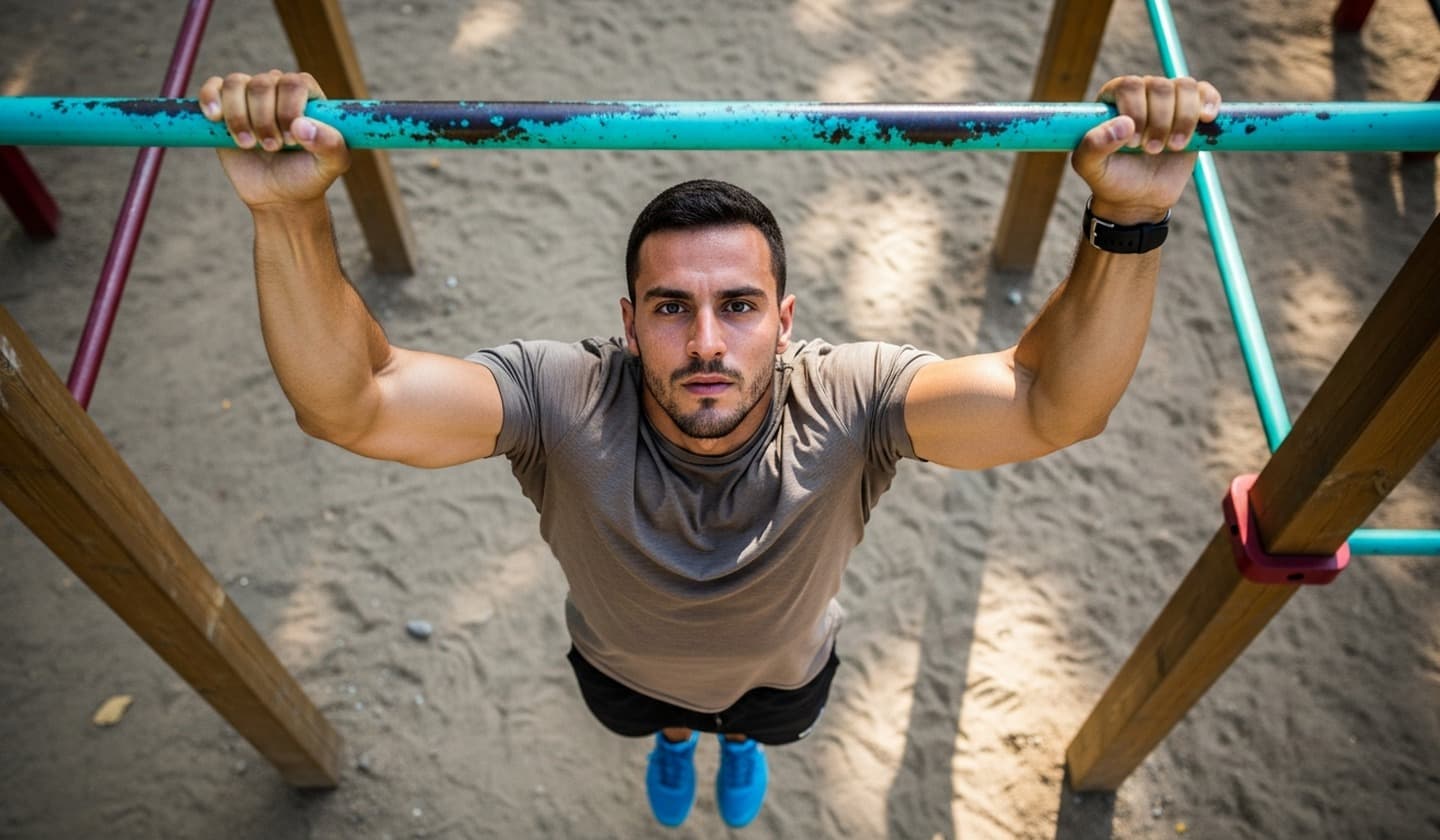
A dead hang is a simple isometric exercise where you hang from an overhead bar with straight arms and relaxed shoulders, letting gravity gently decompress your spine. The benefits compound from a small daily dose: improved shoulder mobility, reduced low-back stiffness, and measurable gains in grip strength, a metric the Lancet’s PURE study (140,000 adults across 17 countries) found is a stronger predictor of cardiovascular mortality than systolic blood pressure [1]. Here’s why a minute a day earns its place, and a 30-day starter plan.
What is a dead hang?
Grab an overhead bar with straight arms, feet off the floor, and hold. That’s it. No pull-up, no swinging. Your grip holds you up while gravity pulls you down.
Trainers classify it as an isometric exercise, the muscles generating force without changing length. A squat or a pull-up shortens and lengthens the muscle through a range of motion; an isometric hold keeps it under tension in one position.
The position loads your forearms and grip, lets your shoulders stretch into full flexion, and gives your spine a gentle pulling force. You feel all of it within about ten seconds.
Is a dead hang an isometric exercise?
Yes. In a dead hang your grip, forearms, shoulders and upper back are all working hard, but nothing is moving: you hold one position against gravity for time. That is the definition of an isometric exercise, the same family as the plank and the wall sit. It is why the dead hang fits so naturally alongside those two in Just Hold.
Five evidence-based reasons to hang
1. It builds grip strength, and that matters more than you’d think
Grip strength is one of the best non-exercise-lab predictors of long-term health. The PURE study, published in The Lancet, followed 140,000 adults across 17 countries. Low grip strength was independently associated with higher all-cause mortality, cardiovascular mortality, and cardiovascular disease, even after adjusting for age, physical activity, and other confounders [1].
Grip strength isn’t destiny, but it’s a useful signal. And unlike many health markers, it’s trainable. A controlled 8-week study of 26 advanced sport climbers compared three hangboard protocols. The intermittent-hang group, work-rest intervals on an edge, gained roughly 45% in grip endurance over the protocol, with a statistically significant gain appearing by the 4-week midpoint [2].
You don’t need to train like a climber to see the benefit. Any honest exposure to sustained grip loading will push the needle.
2. It decompresses a tired spine
When you hang, gravity pulls your ribcage and pelvis away from your hands. Clinicians describe this as axial traction, a gentle pulling force along the length of the spine. Rehabilitation literature on mechanical traction devices (used for specific back and neck conditions) suggests traction can transiently reduce intradiscal pressure and ease nerve-root irritation in some people.
A caveat: most of that evidence comes from clinical traction protocols, not from hanging bars. The mechanism is plausible, the intervention is safe for most healthy people, and many desk workers find it relieving, but treat a daily hang as a useful input, not a cure.
3. It opens locked-up shoulders
The hang position takes your shoulders into full overhead flexion, a range most people lose after years of typing and scrolling. Time under tension in that position lengthens the lats and pectoralis, and asks the rotator cuff and serratus to coordinate an upward-rotated shoulder blade.
Physiotherapists often use variations of the hang in overhead-mobility rehab, and the position features in strength-and-conditioning programs targeting shoulder health. If you can’t comfortably get your arms straight overhead right now, assisted hangs with your feet on a box are a reasonable on-ramp.
4. It’s an isometric, and isometrics are useful
Isometric exercise has seen a research-backed revival. A 2023 network meta-analysis in the British Journal of Sports Medicine synthesised 270 randomised controlled trials of exercise for blood pressure. Isometric training outranked aerobic, dynamic resistance, combined, and HIIT training for reducing resting blood pressure [3].
Dead hangs aren’t the most-studied isometric (wall squats and handgrip holds dominate the literature), but they sit in the same category of training stimulus: sustained muscular tension without movement, at a submaximal intensity. The general case for including isometric work in a training week applies.
5. It’s easy to start, easy to keep doing
You need a bar, a beam, the top of a doorframe, or a tree branch. If you do not have one yet, our guide to the best bar for dead hangs at home walks through the options. You need no warm-up. A useful daily dose is 30 to 60 seconds, broken into whatever chunks you can manage. The low friction is part of the point, consistency is where the benefit actually lives.
How to progress
Week 1–2: tolerate the position. Three sessions per week. Two sets of 10–15 seconds. Feet on a box if you can’t yet hang with arms straight and shoulders active. Goal: get comfortable with the position.
Week 3–4: build time. Three sessions per week. Three sets of 20–30 seconds, with 60 seconds of rest between. Your forearms will burn and your hands will ache. That’s the point.
Week 5 onward: extend or load. Either push total time (sets of 45 seconds, then 60) or add load (small weight belt, 5–10 kg). Stay under 30% of bodyweight added until you’ve accumulated a few months of consistent hanging.
Form checklist
- Shoulder-width overhand grip, thumbs around the bar
- Elbows straight but not hyperextended
- Shoulders active (think “pulled down and back” rather than passively shrugged up)
- Ribs down, light core tension
- Breathe slowly through the nose
- Knees slightly bent if needed to keep feet clear of the floor
A 30-day starter challenge
Hang for 30 seconds a day, broken up however you like, for 30 days. Log it in Just Hold and you can challenge your friends for extra motivation.
Most people notice their grip feels stronger within two weeks, their shoulders feel looser within three, and their desk posture feels less locked up by the end of the month.
- Beginner: 15 seconds total, broken into 3 × 5s if needed
- Intermediate: 30 seconds total, ideally one unbroken set
- Advanced: 45+ seconds, or add weight
Before you start
If you have a diagnosed shoulder injury, cervical radiculopathy, recent back surgery, or any other reason to be concerned, check with your clinician before hanging. For everyone else, dead hangs are one of the lowest-risk additions you can make to a training week, and one of the cheapest.
Give it a month. Your grip, your shoulders, and your desk-worn spine will all say thanks.
Educational content only, not medical advice.
References
- [1] Leong DP, Teo KK, Rangarajan S, et al. Prognostic value of grip strength: findings from the Prospective Urban Rural Epidemiology (PURE) study. The Lancet. 2015;386(9990):266–273.
- [2] López-Rivera E, González-Badillo JJ. Comparison of the effects of three hangboard strength and endurance training programs on grip endurance in sport climbers. 2019.
- [3] Edwards JJ, Deenmamode AHP, Griffiths M, et al. Exercise training and resting blood pressure: a large-scale pairwise and network meta-analysis of randomised controlled trials. British Journal of Sports Medicine. 2023;57(20):1317–1326.