How to Build a Plank Habit That Actually Sticks
A plank habit is the practice of completing one short, deliberate plank session on most days (typically 3 to 5 minutes total, broken into 2 to 4 holds). Research on habit formation (Lally et al., 2010) [1] found that simple daily behaviours take a median of 66 days to become automatic, with a wide range across people, and planks fit the criteria almost perfectly: low friction, time-efficient, measurable, and scalable. This post lays out the four-week framework, the daily cue/reward loop, and why the consistency problem is a systems problem, not a motivation one.
Why planks are good for habit-building
Planks are one of the best entry habits in fitness because they’re:
- Low-friction: no gym, no gear, no special clothes
- Time-efficient: a useful session is 3–5 minutes
- Measurable: time under tension is unambiguous
- Scalable: beginner to advanced with obvious progressions
Unlike random workouts, a plank habit gives you immediate structure: show up, hold with good form, log it, repeat.
Start with identity, not intensity
The fastest way to burn out is starting with “I’ll hold 3 minutes every day.” That’s an outcome. Outcomes are fragile so one missed day and you’ve “failed.”
A sturdier framing is identity-based. Not I’ll hit a huge time, but I’m someone who does their plank ritual every day before coffee.
Your goal in week 1 isn’t consistently making personal best times, it’s proving to yourself that you can be consistent at something small.
The four-part plank habit framework
1. Keep the cue fixed
Attach planks to a stable daily event:
- After brushing your teeth in the morning
- After your first coffee
- Before your shower
- Before dinner
One cue. Don’t rotate. The cue is what makes the behaviour automatic and that’s the mechanism described in the habit-formation literature, where repetition of an action in a stable context is the key driver of automaticity over time [1].
2. Make the first rep tiny
Start with a floor so low you can’t fail:
- 20–30 seconds
- 1–2 sets
- 4–5 days a week
This avoids the all-or-nothing trap which kills habits faster than any other single factor. A 20-second plank still counts on a terrible day.
3. Track immediately
If you don’t log it, your brain undervalues it. This is where a simple app like Just Hold earns its keep, but a paper journal works just as well.
4. Progress slowly
Increase only when your form is clean. As a simple rule, add 5–10 seconds per set, or add one extra set but not both at once.
Form first: what a good plank means
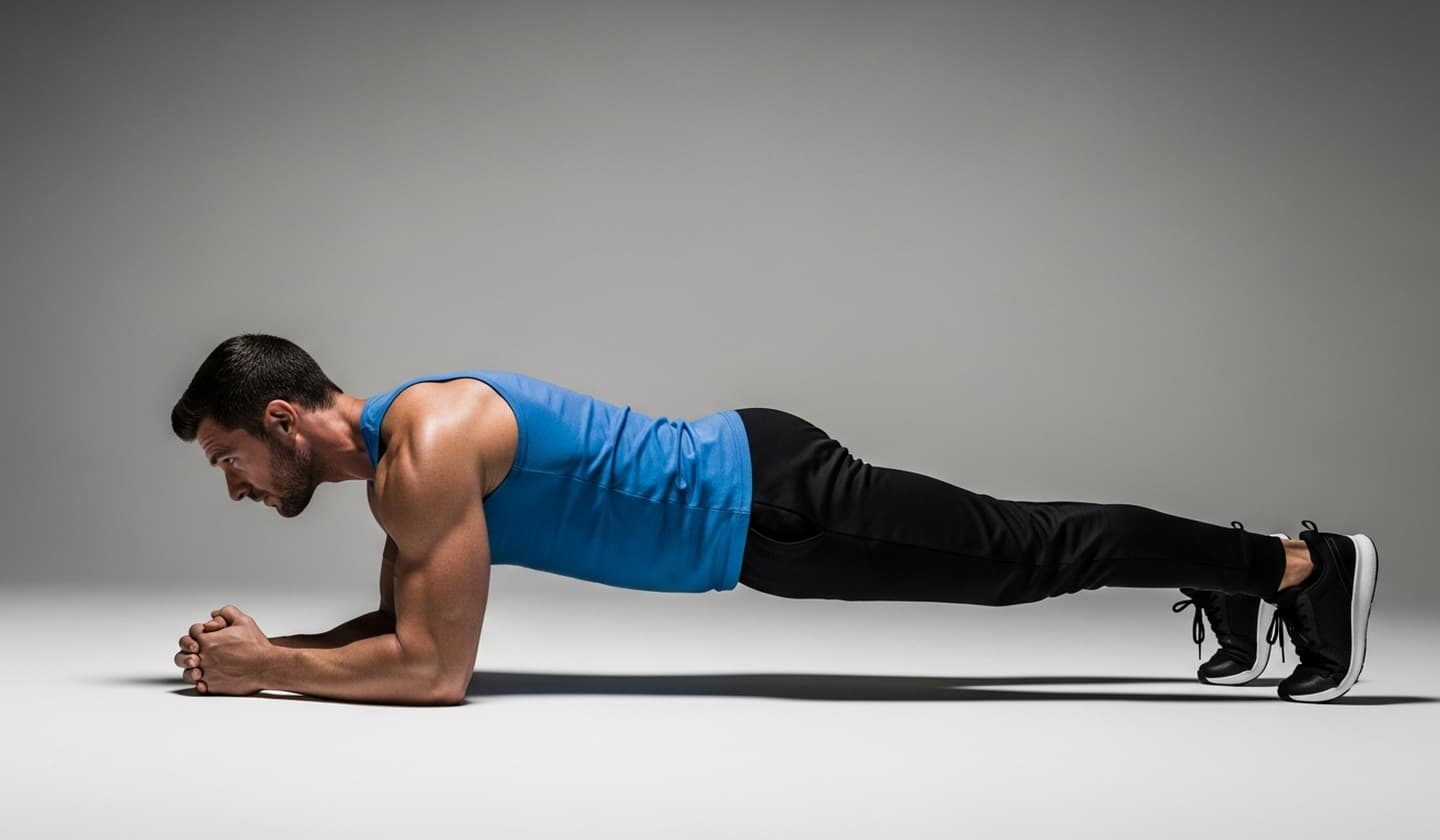
A plank should be structurally sound:
- Elbows under shoulders
- Forearms parallel
- Body in a straight line from heels to head
- Core engaged, glutes lightly active
- No hip sag, no piking
- Calm breathing, no holding your breath
If form breaks, stop. Sloppy reps don’t build a habit, they build bad mechanics that you’ll have to unlearn later.
Your first four-week plan
Week 1 (Installation). 5 sessions. 2 × 20–30s holds. 45–60s rest. Focus: cue consistency and clean form. Goal: not a single missed session.
Week 2 (Stabilisation). 5 sessions. 2–3 × 30–40s holds. Focus: no skipped days. Protect the streak over everything else.
Week 3 (Progression). 5 sessions. 3 × 35–50s holds. Focus: controlled breathing, posture under longer tension.
Week 4 (Consolidation). 5 sessions. 3 × 40–60s holds. One quality test day; hold as long as form is clean. Don’t max out every session.
If you miss a day, resume the next session at the planned level. Don’t double up; don’t punish yourself. Missed days only become real problems when they become two missed days.
The science that makes this work
Two ideas from behaviour-change research do most of the heavy lifting here.
Implementation intentions. A simple if-then plan (“If it’s 8am and I’ve finished my coffee, then I do my plank ritual”) significantly improves follow-through compared to goal-setting alone. The effect was first described systematically by Peter Gollwitzer in a 1999 review in American Psychologist, and subsequent meta-analyses have replicated it across health behaviours [2].
Automaticity through stable repetition. A frequently-cited 2010 study by Lally and colleagues followed adults trying to form new daily habits. Across the 39 participants whose data fitted the model, the time to reach automaticity ranged from 18 days to 254 days depending on the behaviour and person. The median was 66 days but the far more useful finding is the range [1]. Habits take longer than the pop-psychology “21 days” implies, and the variation between people is huge. Plan for months, not weeks. The same study found that missing a single day did not meaningfully set people back, so one skipped session is not a broken streak [1].
Your script should reflect both: “After my morning coffee, I do two planks before I check messages.” Specific. Repeatable. Encoded as a plan, not an intention.
Common mistakes and how to fix them
Going too hard too early. Fix: reduce volume. The habit is the asset; time under tension is secondary.
Chasing time with poor form. Fix: log clean seconds, not raw seconds. A 30-second plank with good form beats 60 seconds of sag.
No bad-day backup. Fix: define a minimum day (1 × 20s) that protects the streak when life goes sideways.
Random timing. Fix: same cue, same place, same sequence. Randomness is where habits go to die.
Final takeaway
If you want a plank habit that lasts, stop thinking like a hero and start thinking like an operator:
- Fixed cue
- Tiny start
- Slow progression
- Clean form
- Immediate logging
Do that for 30 days (or take on a 28-day challenge with friends to make it stick) and planks stop being a decision. They become something you already did before you finished your first coffee.
Educational content only, not medical advice. If you have existing back, shoulder, or core injuries, speak with a qualified clinician before starting a new training routine.
References
- [1] Lally P, van Jaarsveld CHM, Potts HWW, Wardle J. How are habits formed: Modelling habit formation in the real world. European Journal of Social Psychology. 2010;40(6):998–1009.
- [2] Gollwitzer PM. Implementation intentions: Strong effects of simple plans. American Psychologist. 1999;54(7):493–503.