
How Often Should You Do Wall Sits? What the 2026 Trial Found
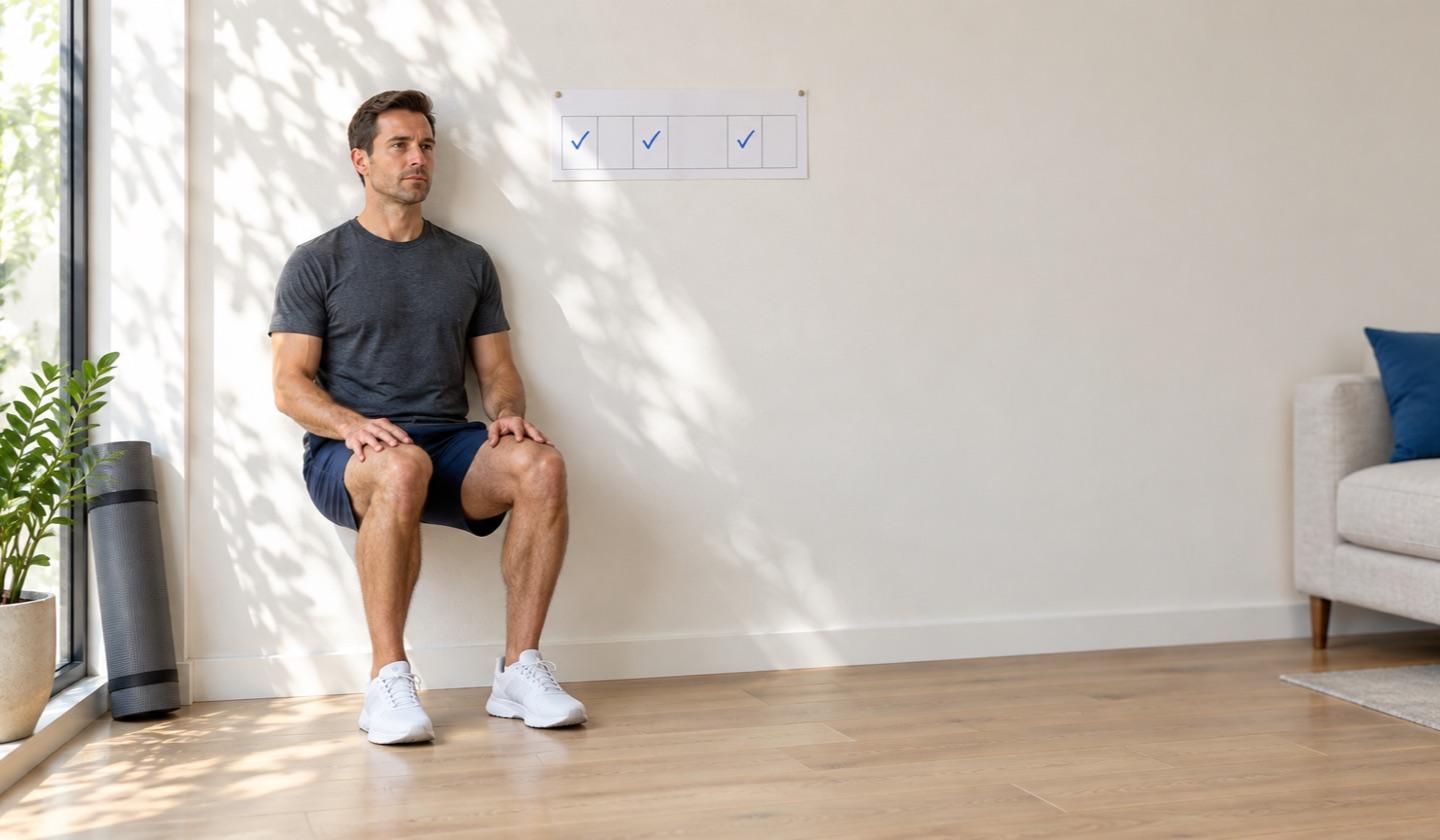
Three times a week, with a rest day between sessions, is the wall sit frequency with the best evidence behind it. In a 2026 randomised trial of 100 adults who did little exercise, the group that kept training three times a week had resting systolic blood pressure 13.73 mmHg below its starting level at eight weeks. The groups training twice and once a week were about 7 mmHg below, and the group that stopped was back to a level not significantly different from the control group [1]. This post covers what the trial did, what each group showed, and what it can’t tell you.
Three things to know before the detail:
- Three sessions a week, 48 hours apart, is the schedule that held up best in the trial [1].
- Everyone trained three times a week for the first four weeks. The lighter schedules were tested as a way of keeping a reduction going, not as a way to start [1].
- The adults had normal to high-normal blood pressure, and the follow-up after the cutback lasted four weeks [1].
How often should you do wall sits?
Three times a week, with 48 hours between sessions, is the frequency the 2026 trial used for its first four weeks and the one that held up best afterwards [1]. Daily sessions weren’t tested, so the trial can’t say whether more than three a week would do better or worse.
Each session was four wall-squat bouts with 2 minutes of seated rest between them. The depth was set for each person in the lab, choosing the knee angle that brought their heart rate to about 95% of the peak they reached in an incremental test, and it was adjusted if their heart rate drifted out of range at home [1]. You won’t have that test at home, so depth is your dial. In a 2014 study of 23 adults holding two-minute wall squats at knee angles from 135 down to 90 degrees, average heart rate rose steadily as the knees bent deeper, from 76 to 119 beats a minute [3]. Shallower is easier, deeper is harder.
What did the 2026 trial find?
The trial, run by a team at Canterbury Christ Church University and published in BMJ Open Sport & Exercise Medicine, put 80 adults through four weeks of home-based wall-squat training three times a week, while 20 more kept to their usual routine as a control group. The trained adults were then split into four groups for another four weeks: three sessions a week, two, one, or none [1]. After the first four weeks, the training groups together averaged 9.45 mmHg lower systolic and 5.47 mmHg lower diastolic pressure than the control group [1].
| Weeks 5 to 8 | Systolic change from baseline |
|---|---|
| Three sessions a week | 13.73 mmHg lower |
| Two sessions a week | 6.95 mmHg lower |
| One session a week | 6.56 mmHg lower |
| No sessions | Not significantly different from control |
The three-a-week group was significantly lower than the other training groups at week 8. Once a week and twice a week were not significantly different from each other, which the authors read as no added benefit from a second weekly session unless you go all the way back to three [1].
Is one wall sit session a week enough?
In this trial, one session a week kept part of a reduction that had been built with three sessions a week over the previous four weeks. It was not tested as a way to start. The authors’ conclusion is that cutting back to one or two sessions a week slowed the rate at which the reductions faded, without stopping them fading, and they describe lighter weeks as a way to buffer short lapses in training [1].
The other measures the researchers tracked, including heart rate variability and how much resistance the circulation was working against, held up only in the three-a-week group [1]. So the picture is partial: a lighter schedule held on to part of the blood pressure result for a few weeks, and the regular schedule held on to more of everything.
Who was in the study, and what doesn’t it show?
- 100 adults, average age 37, 45% women, doing under 150 minutes of moderate activity a week, with systolic pressure of 120 to 140 mmHg. None smoked and none were taking or had taken blood pressure medication [1].
- Eight weeks in total. The authors call the four-week follow-up relatively short and say future trials should check whether the pattern lasts longer [1].
- Participants and researchers knew who was training, which is hard to avoid in an exercise trial [1].
- It tested wall squats at an individually set depth. It didn’t test maximum-time holds, planks or dead hangs [1].
- It reports averages for groups. It says nothing about any one person’s blood pressure, or about people with high blood pressure, who weren’t the group studied [1].
How does this fit with the earlier research?
A 2023 network meta-analysis of randomised trials found isometric exercise was associated with the largest average reductions in resting blood pressure of the five exercise types it compared, with the wall squat ranked highest among individual exercises for systolic pressure [2]. That work asked which kind of exercise does best on average. The 2026 trial asks a narrower question: how often you need to keep going once you have started. For the wider evidence, including what it does not show, see our guide to isometric exercise and blood pressure.
What does a three-a-week wall sit schedule look like?
The trial’s pattern, in plain terms:
- Pick three days with a rest day between, such as Monday, Wednesday and Friday.
- Each session, do four wall sits with 2 minutes of seated rest between them.
- Choose a depth you can hold with a flat back and steady breathing, and make it harder over the weeks by sitting a little deeper.
- If you’re new, start with 20 to 30 second holds and build up over a few weeks. That’s a practical starting point of ours, not the trial’s protocol.
Not sure where you’re starting from? Time one hold on the wall sit timer and it shows which band your time falls in. For where to put your feet and how deep to sit, see how to do a wall sit.
Blood pressure climbs during the hold itself. A 2026 study of 62 healthy adults found it rose substantially during plank and wall sit holds, and reported no adverse events in that group [4]. Breathe throughout and don’t strain. If you have high blood pressure or a heart condition, speak to your doctor before starting [5]. The same goes if you are pregnant or unsure, and don’t change any prescribed medication because of an article.
Frequently asked questions
How many times a week should you do wall sits?
Three, with a rest day between, is the schedule that held up best in the 2026 trial, which followed 100 adults over eight weeks [1]. Daily sessions weren’t tested.
Is once a week enough?
In the trial, once a week kept part of a systolic reduction (6.56 mmHg below baseline at week 8) that had been built with four weeks of three sessions a week. The three-a-week group was further below, at 13.73 mmHg [1]. Once a week wasn’t tested as a starting schedule.
What happens if you stop doing wall sits?
The group that stopped after four weeks was not significantly different from the control group on systolic pressure four weeks later [1]. Four weeks was the longest follow-up, so what happens over longer breaks isn’t known.
Do you need to do wall sits every day?
The trial didn’t test daily sessions. Its schedules were three, two, one and zero a week, and 48 hours between sessions was part of the three-a-week protocol [1].
The bottom line
Three sessions a week with a rest day between has the most support. In this trial a lighter week held on to part of the result for a few weeks, and stopping did not [1]. The part that decides whether any of this applies to you is turning up on Wednesday and Friday as well as Monday, which is a habit question as much as an exercise one.
Three short sessions a week are easy to lose count of. Time your first hold on the wall sit timer to see where it sits, and a free Just Hold account keeps every session after that, with your streak and friends or family to compare against if you like.
This page is for educational purposes only and is not medical advice. If you have health concerns or are unsure whether to start exercising, consult your doctor first.
- Swift HT, Pedlar C, Coleman DA, Buckley JP, Wiles JD. Isometric exercise training and blood pressure control: exploring the dose-response to training frequency in a randomised controlled trial. BMJ Open Sport & Exercise Medicine. 2026;12(3):e003172. doi:10.1136/bmjsem-2025-003172.
- Edwards JJ, Deenmamode AHP, Griffiths M, et al. Exercise training and resting blood pressure: a large-scale pairwise and network meta-analysis of randomised controlled trials. British Journal of Sports Medicine. 2023;57(20):1317–1326.
- Goldring N, Wiles JD, Coleman D. The effects of isometric wall squat exercise on heart rate and blood pressure in a normotensive population. Journal of Sports Sciences. 2014;32(2):129–136.
- Jones MD, Tan E, Woo J, Bui E, Wong R, Fotheringham A, Schutte AE, Parmenter BJ. Acute blood pressure responses to plank and wall sit isometric exercise in adults. Journal of Hypertension. 2026;44(2):288–294.
- Mayo Clinic. Isometric exercises: Good for strength training?