28-Day Plank Challenge: A Personalised 4-Week Plan to Improve Your Plank
A 28-day plank challenge is a four-week plan to improve how long you can hold a plank. The most effective version is not a fixed calendar of ever-longer holds, it is built around your own starting time: you test your max, follow a plan that scales to it, then re-test at the end to see how far you have come. This guide gives you the plan itself, the test-and-retest method behind it, and how to make it stick by doing it with friends.
Why a personalised plank challenge beats a fixed one
Most plank challenges hand everyone the same daily number. That is impossible for a beginner and pointless for someone who can already hold two minutes. A plan built around your own starting time fixes both problems: it stays challenging without breaking your form, and it lets a beginner and a regular gym-goer take on the same challenge from their own starting line.
It also keeps the focus where it belongs, on clean form rather than a big number. A shorter hold with a flat back beats a long one that sags, every time.
The 28-day plank plan, week by week
The shape that works is simple: build gradually, push in week three, ease off, then test. Your daily targets sit comfortably below your max so you can train often without your form breaking down, and the improvement shows up at the re-test. Here is the structure:
| Week | Goal | Sessions | Effort |
|---|---|---|---|
| 1 | Build the habit | 3 | Easy, clean holds |
| 2 | Add time | 3 to 4 | Moderate |
| 3 | Push | 3 to 4 | Hardest week |
| 4 | Taper and test | 2 light + test | Fresh for day 28 |
Your actual numbers come from your day-one test. Here is how three different starting points look across the three build weeks, three sets each time:
| Day-one max | Week 1 | Week 2 | Week 3 |
|---|---|---|---|
| 20 sec | 3 × 12 sec | 3 × 15 sec | 3 × 18 sec |
| 40 sec | 3 × 22 sec | 3 × 28 sec | 3 × 34 sec |
| 60 sec | 3 × 35 sec | 3 × 42 sec | 3 × 50 sec |
The test-and-retest method
Test your max on day one and again on day 28, and the gap between the two is your result. Testing at the start anchors the plan to you, and re-testing at the end turns four weeks of quiet sessions into a clear before-and-after. Re-testing roughly every four weeks is a sensible rhythm, often enough to see progress, not so often that you are maxing out and grinding down your form. Track each test in one place so the before-and-after is honest.
What a good plank looks like
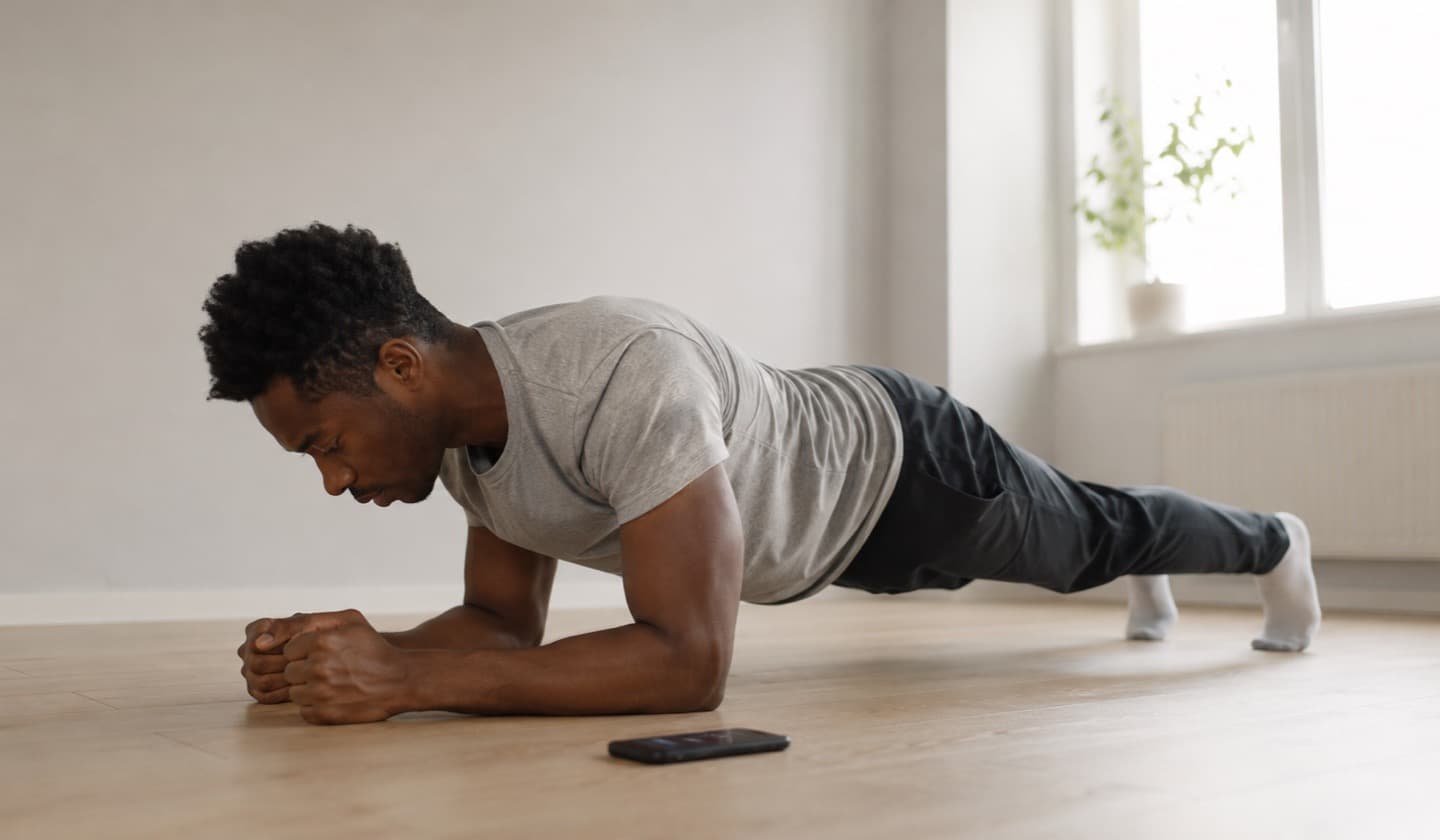
The clock only counts while your form is clean. Run through this and stop the moment it slips:
- Elbows under your shoulders, forearms flat
- A straight line from heels to head, no sagging hips or piking up
- Core braced, glutes lightly engaged, ribs down
- Calm, steady breathing, never holding your breath
- Neck neutral, eyes on the floor
Spine researcher Stuart McGill’s work frames core training less as movement and more as bracing, teaching the torso to resist motion under control [1]. That fits the logic of this plan: repeated clean holds, not one ugly grind to failure.
Make it stick: do it with your group
A challenge you do alone is easy to quietly drop. A challenge your friends can see is not. Start the 28-day challenge, share one link, and your group follows their own plans while you all share a leaderboard.
And the best leaderboard is not the one with the strongest person at the top, it is the one where everyone has a reason to come back tomorrow. That is why "most improved" matters: a beginner can win it, and the people most likely to give up get a reason to stay.
Frequently asked questions
How many days a week should I plank?
Three to four short sessions a week is plenty, with rest days in between. Planking hard every single day leaves no room to recover and pushes your form downhill.
Should I do one long plank or several shorter ones?
Several shorter holds with good form beat one long hold that collapses. Clean repetitions are what build a stable core [1][2].
What if I miss a day?
Nothing breaks. Pick up the next session where you left off and carry on. Missed days only become a problem when they turn into missed weeks.
How much can I improve in 28 days?
It varies a lot by where you start and how consistent you are, and beginners tend to improve fastest. Rather than chase a fixed number, measure your own before-and-after and aim to beat it.
Do I need any equipment?
None at all. A plank needs a bit of floor and a timer, which is the whole appeal.
The bottom line: a 28-day plank challenge works best when it is built around your starting time, kept honest on form, and shared with people who will notice if you go quiet. Test, follow the plan, re-test, and let the number take care of itself.
Educational content only, not medical advice. Stop if your form breaks, and if you have back, shoulder or other health concerns, speak with a clinician before starting a new training routine.