
30-Day Plank Challenge Chart: The Full Plan, Day by Day
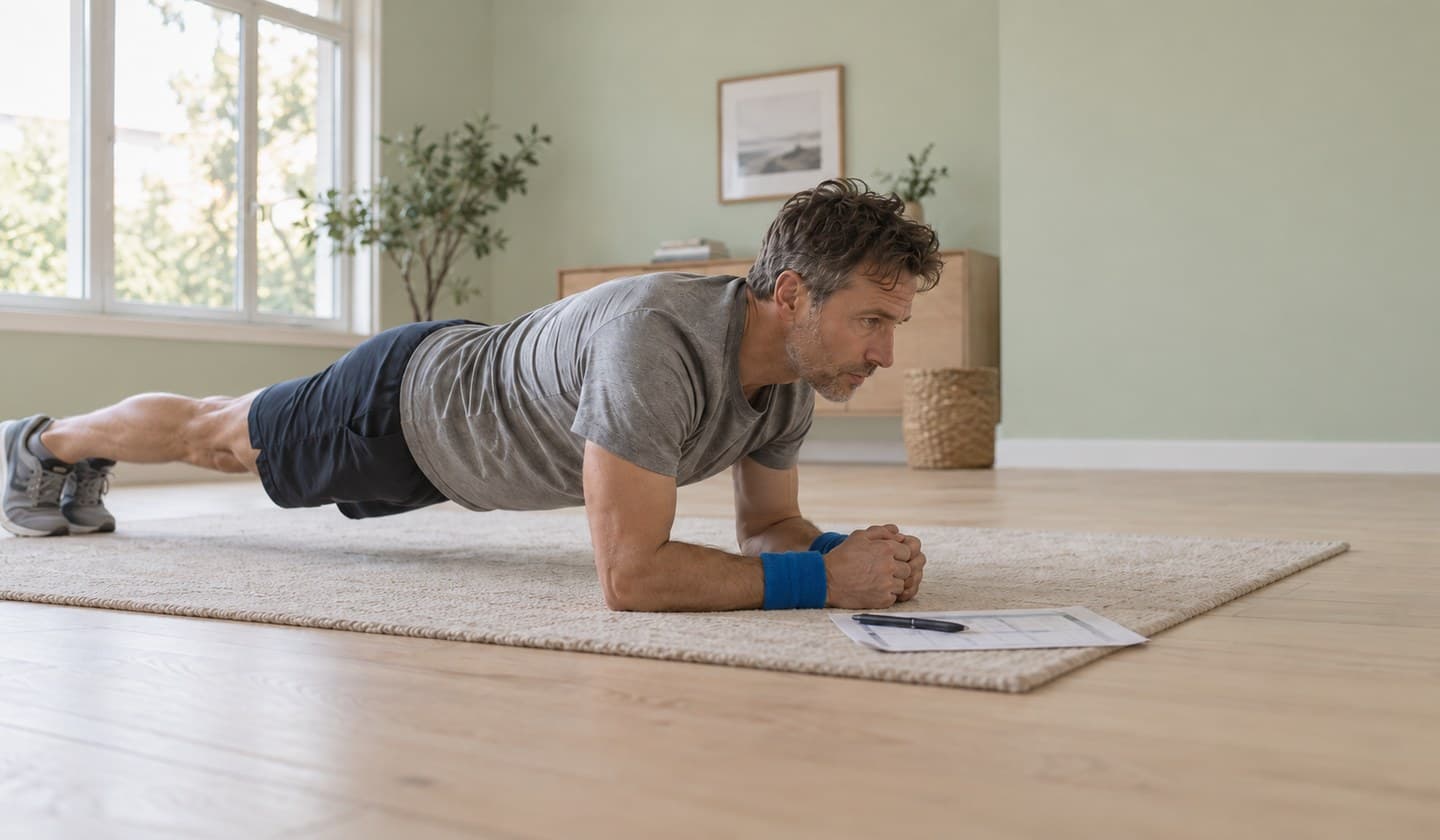
A 30-day plank challenge is a month of plank sessions that get harder week by week. The chart below does it differently from the usual one: day one is a test, the next four weeks scale every target to the time you actually held, rest days are built in, and day 30 is a retest. So the plan fits a 15-second beginner and a two-minute regular equally well.
The 30-day plank challenge chart
Here is the whole month at a glance. The percentages are of your own day-one time, and every session is a set of holds with 30 to 45 seconds of rest between them.
- Day 1: test. One plank to your limit. Write the number down.
- Days 2 to 6: three holds at 60 per cent of your day-one time.
- Days 7 and 8: rest.
- Days 9 to 13: three holds at 70 per cent.
- Days 14 and 15: rest.
- Days 16 to 20: four holds at 85 per cent. This is the hard week.
- Days 21 and 22: rest.
- Days 23 to 27: two holds at 60 per cent. Ease off.
- Days 28 and 29: rest.
- Day 30: retest. One plank to your limit again.
Keep breathing steadily the whole way through a hold, and stop if anything hurts or you feel light-headed. A hold you stop early is worth more than one you push through badly.
What that looks like in seconds
Four worked examples, rounded to the nearest second. Find the row nearest your day-one time, or do the sums on your own number.
- Day-one time 20 seconds: 12s, then 14s, then 17s, then 12s.
- Day-one time 40 seconds: 24s, then 28s, then 34s, then 24s.
- Day-one time 60 seconds: 36s, then 42s, then 51s, then 36s.
- Day-one time 90 seconds: 54s, then 63s, then 76s, then 54s.
How we built this chart: a baseline test places you, the training weeks sit at 60, 70 and 85 per cent of that number so you are never training at your limit, there are eight rest days between the two test days, and the work is split into repeated holds rather than one long one. It is a practical challenge format rather than a protocol from a paper, and the section below explains which parts research does and does not speak to.
The classic chart, and why we changed it
One of the most widely circulated 30-day plank charts starts at 10 seconds on day one, adds 10 seconds a day, and reaches five minutes on day 30 with no rest days [1]. It is not the only version in circulation, Garmin publishes one that opens at 20 seconds and builds in four rest days [2], but the 10-seconds-to-five-minutes ladder is the one most people mean. Three things about it are worth changing.
It gives everyone the same starting point
Day one is 10 seconds whether your current best is 15 seconds or two minutes. For the first person the final week is out of reach; for the second, much of the opening fortnight is barely a session. A plan that does not move you is a calendar, not a challenge.
It has no rest days
Thirty consecutive days with the load rising every single one leaves no room for a bad night, a busy Tuesday or ordinary soreness. Miss a day on a chart with no slack in it and it is easy to feel you are already behind.
Five minutes is not the target it looks like
In a therapeutic and corrective-exercise context, McGill recommends keeping isometric holds short and building endurance through repetitions rather than one long hold [3]. That is a narrower setting than a general fitness challenge, and it does not prescribe the hold times in our chart, but it does undercut the idea that one ever-longer plank is the only route to better endurance. A five-minute hold is closer to a test of tolerance than a training session.
What to do when you miss a day
Take it as an extra rest day and carry on at the same target. Do not double up and do not restart the chart. The habit-formation study below looked at exactly this and found that a single missed opportunity did not meaningfully set people back [4], which matches the practical version: the challenge that works is the one you are still doing on day 30.
Does 30 days make it a habit?
Probably not on its own. In a study of people taking up a new daily behaviour, the median time to reach 95 per cent of maximum automaticity was 66 days, and individual estimates ranged from 18 to 254 days across the 39 participants whose data fitted the model [4]. Thirty days is a reasonable window to see your plank time move. It is not an established threshold for the behaviour becoming automatic.
Doing it with other people
There is decent evidence for the social side. A 2023 meta-analysis of 19 studies and 1,912 participants found that people exercising as interdependent pairs, where the pair result depends on the weaker person, put in more effort than people exercising alone [5]. In many of the underlying experiments the partner was moderately stronger, not marginally so. A friends leaderboard is not that experimental setup, so treat it as a nearby finding rather than a promise, but the broad point holds: other people watching changes how hard most of us are willing to work. Our post on the Köhler effect goes through the research in more detail.
Thirty days and four weeks are the same thing with a test day at each end. If you would rather not do the arithmetic yourself, the 28-day challenge in the app runs those four weeks (settle in, build, push, then ease off and test) across the plank, the dead hang and the wall sit.
Frequently asked questions
Is the 30-day plank challenge chart suitable for beginners?
The classic version is not, because it reaches two minutes by day 12 and three minutes by day 18. The chart above is, because every target is a share of your own day-one time. If you held 12 seconds on day one, week one is three holds of about seven seconds.
Should I plank every day for 30 days?
You do not need to. This chart has 20 training days and eight rest days between the two tests, which is plenty of practice and leaves room for the days life gets in the way.
What is a good plank time at the end of 30 days?
Your own day-one time is the only fair comparison, because the gap between the two tests is what you actually changed. If you want a population yardstick alongside it, our post on average plank time by age sets out what the research does and does not show.
Can I use the same chart for a wall sit or a dead hang?
Use the same test, train, retest structure, but not the same numbers. A plank, a wall sit and a dead hang load different muscles and usually produce very different starting times, so test each one separately and scale its targets from its own baseline.
The bottom line
The 30-day plank challenge is a good idea built on a bad assumption, that everyone starts in the same place. Test on day one, train at a share of that number, take the rest days, and retest on day 30.
- Day 1: test to your limit and write the number down
- Days 2 to 27: four weeks at 60, 70, 85 then 60 per cent, five days on and two off
- Day 30: retest to your limit
- Day 31: decide what you are going to keep doing
Doing it alongside two or three other people is the part that tends to carry the last week, which is why Just Hold puts everyone’s times side by side.
This page is for educational purposes only and is not medical advice. If you have health concerns or are unsure whether to start exercising, consult your doctor first.
- Chertoff J. 30-Day Plank Challenge. Healthline, 2019. Medically reviewed by Daniel Bubnis, MS, NASM-CPT.
- Garmin. Sculpt Your Core With The Plank Challenge.
- McGill SM. Core Training: Evidence Translating to Better Performance and Injury Prevention. Strength and Conditioning Journal. 2010;32(3):33–46.
- Lally P, van Jaarsveld CHM, Potts HWW, Wardle J. How are habits formed: Modelling habit formation in the real world. European Journal of Social Psychology. 2010;40(6):998–1009.
- Samendinger S, Hill CR, Ahn S, Feltz DL. The Köhler Motivation Gain Effect With Exercise Tasks: A Meta-Analysis. Kinesiology Review. 2023;12(3):187.