
How Long Should You Hold a Plank?
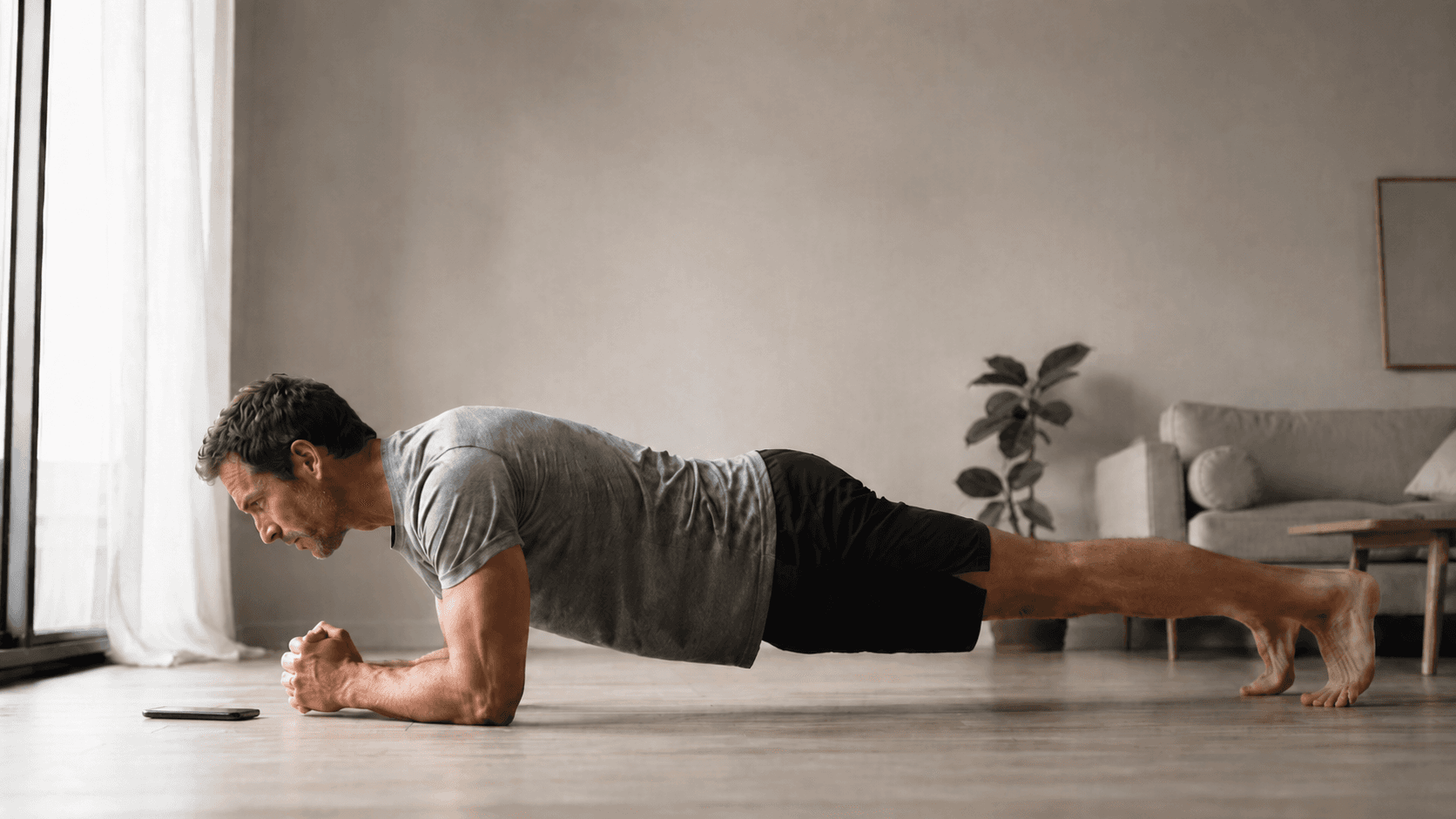
For most healthy adults, a useful plank target is 30 to 60 seconds held with clean form. Past about a minute, the return for most general fitness goals starts to diminish: you are increasingly training static endurance and discomfort tolerance rather than getting a proportionate increase in useful core stability. Spine biomechanist Stuart McGill’s work supports the idea that repeated short, high-quality isometric holds can be more useful than one long, deteriorating hold, especially in corrective or back-health contexts [1]. This guide covers what counts as a good plank time by fitness level, what the research says about duration, why multi-hour plank records are not a sensible training target, and how to progress safely.
How long should you hold a plank? The short answer
There is no single universal number, and these are practical benchmarks rather than clinical cut-offs. Treat them as form-first targets: the clock only counts while your technique is clean.
- Beginner: 20 to 30 seconds, held with a flat back and no hip sag
- Intermediate: 30 to 60 seconds
- Advanced: 60 seconds or more (or move to harder variations rather than just adding time)
Many experts suggest that 10 to 30 seconds, repeated across a few sets, is plenty for most people, with one to two minutes as a sensible upper progression rather than a target to push beyond [3]. A clean 60-second plank is a solid benchmark for a healthy adult: if you can hold three tidy sets in the 30 to 60 second range, your core endurance is in good shape for everyday life and most training goals.
Why longer isn’t better
Once you can hold a clean minute, adding more seconds tends to give diminishing returns for general fitness. McGill’s clearest recommendation in his 2010 core-training paper is made in the context of therapeutic and corrective exercise: keep isometric holds short, build endurance through repetitions, and maintain impeccable form [1]. That does not mean every healthy adult must stop at exactly ten seconds. It does mean the goal is not simply to survive longer.
The useful part of a plank is the high-quality bracing pattern. Once your hips sag, your lower back arches, or your breathing changes, the set has largely stopped doing the job you want it to do. Short, repeated holds let you keep that bracing pattern clean every time, which is the part that transfers to a stable, well-protected spine.
What about the people who plank for hours?
You may have seen the headlines. Guinness World Records currently lists the men’s abdominal plank record as 9 hours, 38 minutes and 47 seconds, achieved by Josef Šálek in Pilsen, Czechia, in May 2023 [2]. Records like that are extraordinary feats of endurance and discomfort tolerance, but they are not a sensible fitness target. For most people, a clean 30 to 60 seconds repeated for a few sets will do more than chasing one long, collapsing hold.
What a good plank actually looks like
Duration only counts if the position is sound. Run through this checklist and end the set the moment the form breaks:
- Elbows directly under your shoulders, forearms flat
- A straight line from heels to head (no sagging hips, no piking up)
- Core braced and glutes lightly engaged
- Ribs down, not flared
- Calm, steady breathing, never holding your breath
- Neck neutral, eyes on the floor
If your hips drop or your lower back starts to arch, that is the end of the useful part of the set. A shorter plank with a flat back beats a longer one that collapses.
How to progress your plank
Progress by improving quality first, then volume, then difficulty, in that order:
- Earn clean time. Add about 5 seconds per session until you can hold 2 to 3 sets of 30 to 60 seconds with no form breakdown.
- Add sets before length. Three sets of 40 seconds is usually more useful than one set of two minutes.
- Make it harder, not just longer. Once 60 seconds is easy, progress with harder variations (a long-lever plank, a single-arm or single-leg reach, or a stability-ball plank) instead of simply adding minutes.
Whichever route you take, the principle is the same: the plank should stay challenging without your technique falling apart.
Frequently asked questions
Is a two-minute plank good?
It shows solid endurance, but for most people it is not a necessary goal. Guidance aimed at general fitness often suggests 10 to 30 seconds in several sets is plenty, with one to two minutes as an upper progression rather than something to push past [3]. Once you can hold a clean minute, your time is usually better spent on harder variations or extra sets than on longer single holds.
Should I do one long plank or several short ones?
Several short, high-quality holds are generally the better choice. Repeated holds let you keep good form throughout, and clean repetitions are what build a stable core, particularly in corrective or back-health contexts [1][3].
How long should a complete beginner hold a plank?
Start at 10 to 30 seconds, or shorter if your hips sag before then, and do a few sets [3]. Build the habit and the form first, and the seconds follow.
Does holding a plank longer burn more fat?
No. Plank duration is not a meaningful fat-loss lever on its own. Core exercises can strengthen and tone the underlying muscles, but it takes aerobic activity, alongside overall healthy eating and activity habits, to reduce body fat. Hold planks to get better at planks, not to chase a number on the scale.
How long should I plank each day?
A few minutes total is plenty. Two or three holds of 30 to 60 seconds, with a short rest between, done most days, beats one long grim hold once a week. If you are past a minute comfortably, add a set or move to a harder variation rather than chasing longer and longer times.
How long should I plank for abs?
The plank trains the muscles that hold your trunk still, and it does that in the first 30 to 60 seconds; holding for five minutes mostly trains you to tolerate holding for five minutes. Whether you can see your abs is a different question, mostly about body fat, and no plank length changes that on its own. For a stronger, more stable middle, several clean holds of under a minute are the better use of your time.
How long can the average person hold a plank?
The most-cited published dataset is 471 college-aged students, where the median was 110 seconds for men and 72 seconds for women [5]. A smaller study of 120 adults across two age bands (20 to 35 and 60 to 79) reported an overall mean of about 145 seconds, with the younger band holding longer [6]. Neither group is a stand-in for the general adult population, so a clean minute is a respectable result for most adults. There is more detail, including the figures by age and sex, in average plank time by age.
Is there a plank time chart by age?
Not a reliable one. No large study reports plank times decade by decade, and the widely quoted “10 to 15 percent per decade after 35” figure has no traceable primary source. Use the times above as a rough guide and compare against your own previous holds.
The bottom line
The plank time that matters is the longest one you can hold with clean form, and then a little less than that, repeated often. For most people that means a few sets in the 30 to 60 second range, done consistently, with harder variations added over time rather than ever-longer holds. The number is a side effect of good training, not the goal.
If you want your plank time to actually improve, the trick is to measure it and keep showing up. Just Hold times your holds, tracks your personal best, and puts you on a leaderboard with your family or friends, which turns “I should plank more” into a streak you do not want to break. You can start for free, no card required.
Educational content only, not medical advice. If you have existing back, shoulder, or core injuries, or you have high blood pressure or a heart condition, speak with a qualified clinician before starting isometric exercise. Avoid holding your breath or straining during a hold, which can cause a sharp rise in blood pressure [4].
References
- [1] McGill SM. Core Training: Evidence Translating to Better Performance and Injury Prevention. Strength and Conditioning Journal. 2010;32(3):33–46.
- [2] Guinness World Records. Longest time in an abdominal plank position (male).
- [3] Harvard Health Publishing. Straight talk on planking. 2019.
- [4] Mayo Clinic. Isometric exercises: Good for strength training?
- [5] Strand SL, Hjelm J, Shoepe TC, Fajardo MA. Norms for an Isometric Muscle Endurance Test. Journal of Human Kinetics. 2014;40:93–102.
- [6] Bohannon RW, Steffl M, Glenney SS, et al. The prone bridge test: Performance, validity, and reliability among older and younger adults. Journal of Bodywork and Movement Therapies. 2018;22(2):385–389.