The Köhler Effect: Why You Hold a Plank Longer With a Partner
The Köhler effect (often written Kohler effect) is the finding that the weaker member of a team often works harder than they would on their own, particularly when the group’s result depends on them. It was first documented in 1926 with a Berlin rowing club, and the modern research on it has been run largely on planks: in one Michigan State study, people held an isometric plank around 24 percent longer when they did it alongside a more capable partner than when they did it alone [1][2]. This post covers what the effect is, what the plank studies actually found, the two conditions that make it work, the one thing that reliably backfires, and how to use it in your own training.
What is the Köhler effect?
It is named after Otto Köhler, who in the 1920s ran a set of experiments with members of a Berlin rowing club. The task was deliberately horrible: standing curls with a heavy weight (around 44 kg) held until the point of exhaustion. Sometimes people did it alone. Sometimes they did it in pairs, with a rule that made the pair’s effort inseparable: the pair could only keep going as long as its weaker member. When the weaker one gave up, it was over for both [5].
The pairs lasted longer than the individuals. The weaker members, in other words, were digging deeper than they did on their own. That is the Köhler effect: being the weak link, under the right conditions, makes you try harder rather than coast.
Why the research ended up running on planks
If you want to measure motivation cleanly, an isometric hold is close to a perfect laboratory task. There is no skill to confound it, no pacing strategy, no technique to hide behind. There is just one number: how long you held on before you stopped. Persistence is the whole measurement.
So when Deborah Feltz, Norbert Kerr and Brandon Irwin at Michigan State set out to test whether the Köhler effect would survive in an exercise-game setting, they reached for the plank. In their 2011 study, published in the Journal of Sport and Exercise Psychology, participants first held a series of planks alone, for as long as they could. After a rest, those in the partner conditions were told they would continue with a same-sex partner, present virtually, whose performance they could watch. The partner’s times were manipulated to always be better than the participant’s [1].
Persistence was significantly greater in every partner condition than in the alone condition. The university reported the headline number as roughly 24 percent longer holds with a more capable partner [1][2].
How much longer? The numbers
The plank research has produced some strikingly large effects for something as simple as letting people see someone else’s time:
- Around 24 percent longer plank holds when exercising alongside a more capable virtual partner, compared with exercising alone [1][2].
- In a follow-up study using an online exercise game, participants paired with a stronger partner (and no encouragement) persisted about 61 seconds longer than those working alone, which the authors reported as a Köhler effect of roughly 100 seconds [3].
- A 2023 meta-analysis in Kinesiology Review pooled the exercise studies of the Köhler motivation gain effect, which is the best current synthesis of how consistently it shows up across this literature [4].
The two conditions that make it work
1. Your partner should be better than you, but not much better
This is the part people get wrong. Köhler’s original finding was that the motivation gain appeared when the gap between the two people was moderate. When the discrepancy was too wide, the effect faded away [5]. It makes intuitive sense: if someone is a little ahead of you, they are a target. If they are absurdly ahead, they are a different species, and you stop trying to catch them.
So the ideal training partner is not the fittest person you know. It is the person just annoyingly better than you.
2. Your effort has to be visible and count for something
Köhler’s original set-up was conjunctive: the pair’s performance was capped by its weakest member, so the weak link’s effort was decisive. Being indispensable is motivating.
Interestingly, the 2011 plank study found the conjunctive condition was no more motivating than the other partner conditions [1]. Simply having a better partner you could see appeared to do much of the work on its own. The practical read: you do not need an elaborate team scoring system. You mostly need a visible comparison with someone slightly better than you.
The thing that backfires: cheering
Here is the finding that surprises everyone. The same researchers ran a study, published in the Journal of Medical Internet Research and titled, with admirable bluntness, "Silence is Golden". They tested whether encouragement from the stronger partner would boost the weaker person’s effort even further.
It did the opposite. The motivation gain was present when the partner said nothing, and encouragement from the stronger member mitigated those gains, particularly when the weaker person perceived the comments as being aimed at someone other than themselves [3].
So if your partner is grinding out a plank and you want to help: do not shout "come on, you’ve got this". Just hold your own plank where they can see it. The comparison motivates. The commentary does not.
The most useful detail for the rest of us: the partner can be virtual
The partners in this research were not in the room. They were presented virtually, and in later studies were software-generated entirely [1][6]. The effect still showed up. That matters, because it means you do not need a training buddy who lives nearby and shares your schedule. You need a visible comparison: someone slightly better than you, whose number you can see.
A shared leaderboard, in other words, is not a gimmick bolted onto exercise. It is the mechanism the research was testing.
How to use the Köhler effect in your own training
- Pick a partner who is a bit better than you, not miles better. Moderately ahead is the sweet spot.
- Make the times visible. You cannot compare yourself against a number you cannot see.
- Hold at the same time, or at least log against each other, so the comparison is live rather than abstract.
- Give the effort a shared stake, such as a group challenge or a team total, so your number matters to someone else.
- Resist the pep talk. Let the comparison do the work.
- Rotate who the "weak link" is, across different exercises, so the same person is not always last. Being permanently the weakest is demotivating over time, a limitation the researchers themselves flag.
Frequently asked questions
What is the Köhler effect in simple terms?
It is the tendency for the weaker member of a team to work harder than they would alone, especially when their effort is visible and matters to the group result. It was first shown in 1926 and has since been demonstrated repeatedly on exercise tasks, particularly plank holds [1][4][5].
Does the partner have to be better than me?
Yes, and by the right amount. The gains appeared when the ability gap was moderate, and faded when the gap was too wide [5]. Someone slightly better than you is a target. Someone vastly better is just discouraging.
Does it work with a virtual or app-based partner?
That is precisely what the modern studies tested. The partners were virtually present, and in later work software-generated, and the motivation gain still appeared [1][6]. Seeing the other person’s time seems to be the active ingredient, not their physical presence.
Should I encourage my partner while they hold?
The evidence suggests not. In the "Silence is Golden" study, encouragement from the stronger partner reduced the motivation gain rather than adding to it [3]. Holding your own plank in view of theirs appears to be the more effective form of support.
Is it Köhler effect or Kohler effect?
The same thing. Otto Köhler was the German psychologist who documented it in 1926, and the umlaut is usually dropped in English writing, so you will see both spellings. Search for either and you will land on the same research.
The bottom line
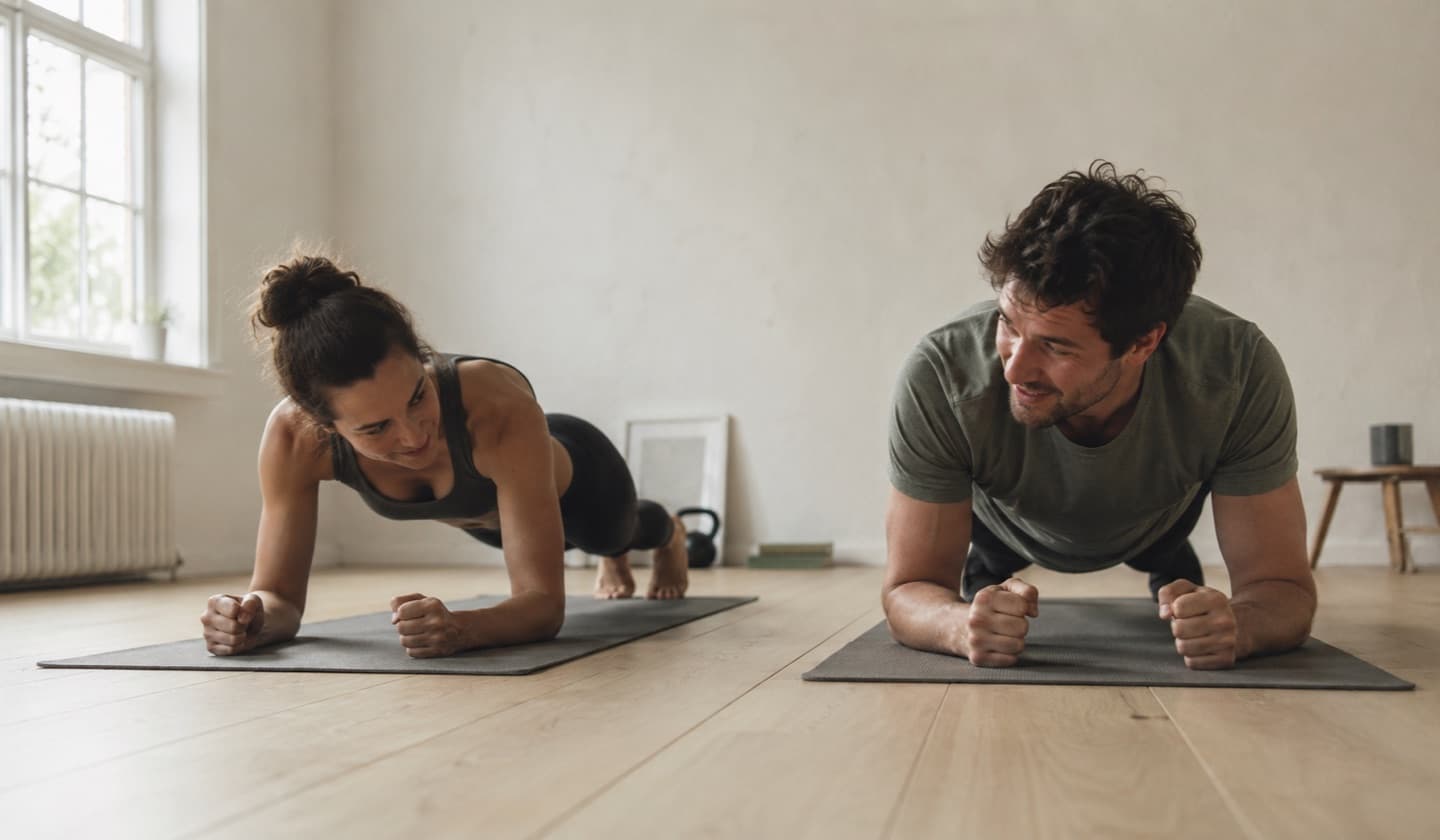
The most effective upgrade to your plank might not be a better programme, a better mat, or a better playlist. Based on this research, it might simply be someone slightly better than you, holding a plank at the same time, where you can see their number. That is a hundred-year-old finding about Berlin rowers that happens to have been re-tested, over and over, on exactly the exercise you are already doing.
This is the idea Just Hold is built around. You log your holds, your friends or family log theirs, and everyone’s times sit side by side on a shared leaderboard, which is the visible comparison the research keeps pointing at. It is free to start: create a group, add a few people who are roughly your level, and see what happens to your plank time when someone slightly better than you is on the board. The easiest way to give the whole group a shared stake is to run a challenge with them. If you would rather follow a printed plan, our 30-day plank challenge chart scales every target to each person’s own day-one time, so a mixed group can run it side by side.
Educational content only, not medical advice. If you have existing back, shoulder, or core injuries, or any health concerns, speak with a qualified clinician before starting a new training routine, and stop a hold if your form breaks.
- Feltz DL, Kerr NL, Irwin BC. Buddy up: the Köhler effect applied to health games. Journal of Sport and Exercise Psychology. 2011;33(4):506–526.
- Michigan State University (MSUToday). Virtual workout partners spur better results. 2011.
- Irwin BC, Feltz DL, Kerr NL. Silence is golden: effect of encouragement in motivating the weak link in an online exercise video game. Journal of Medical Internet Research. 2013;15(6):e104.
- The Köhler motivation gain effect with exercise tasks: a meta-analysis. Kinesiology Review. 2023;12(3):187.
- Encyclopaedia Britannica. Köhler effect (Otto Köhler’s original Berlin rowing club studies and the moderate-discrepancy condition).
- Samendinger S, Bruneau M, Hill CR, Rowe TA. Motivation in team exergames: testing the Köhler discrepancy effect with a software-generated partner during plank exercise. Games for Health Journal. 2021.