
Average Dead Hang Time by Age: What the Research Actually Shows
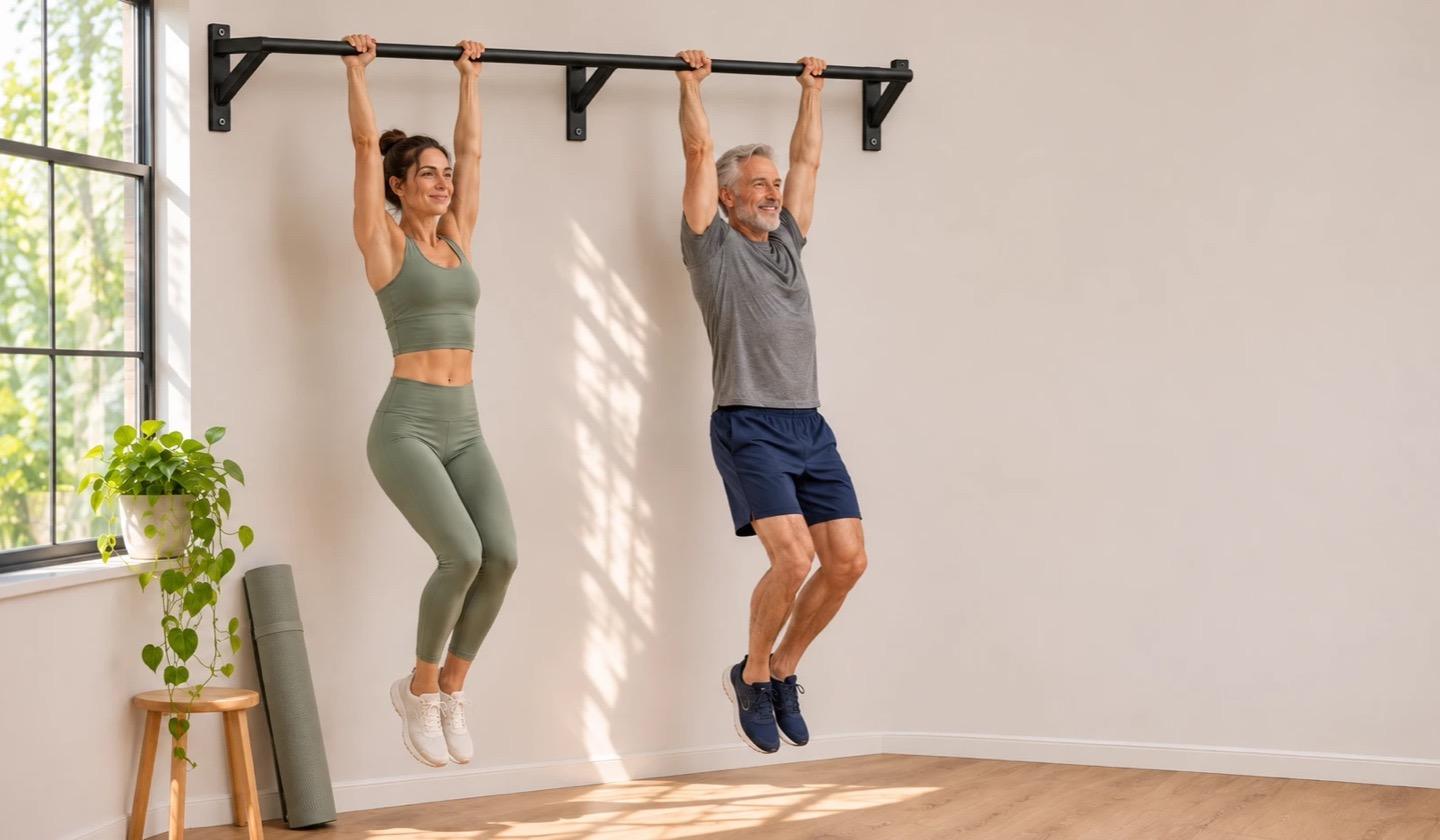
There is no published, age-by-age norm for how long adults can dead hang. We could not find a study that reports average dead hang times across the decades of adult life, so the age charts online are coaching convention rather than research. What does exist is data on grip strength by age [1], a different measurement that shows the general shape of the decline. This post covers what a good time looks like, what the research can and cannot say about age, and how to test your own hang so the number means something.
Want to see where you sit now? Time your hang here and the chart will place it against the same coaching bands used below. Free, no signup needed.
What’s a good dead hang time?
On the Just Hold chart, 30 to 60 seconds is labelled solid, 60 to 90 seconds is good, 90 seconds to 2 minutes is strong, and over 2 minutes is excellent. Under 20 seconds is just starting, and 20 to 30 seconds is a beginner base. These are coaching conventions, not research norms, and they assume a hang with straight arms and your feet off the floor.
A good time is also relative to the bar. Bar thickness and surface change how hard it is to hold on, so compare times on the same bar. If you are choosing one, our guide to the best bar for dead hangs at home covers the options.
What’s the average dead hang time?
There is no research figure for it. As of November 2026 we found no published study that measured dead hang time in a general adult sample and reported an average, a median or percentiles. Any single average you see quoted online is an estimate from coaching experience or a community, not a measured result.
It also pays to check which test a source is describing. A dead hang means hanging from a bar with straight arms for as long as you can hold on. A flexed-arm hang (also called a bent-arm hang) means holding your chin above the bar with bent arms. Its times are not dead hang times, so a figure from one cannot be read as the other.
Average dead hang time by age
No source we could find gives dead hang time by age. The tables that circulate, with a row for each decade, are coaching convention. Where they cite anything, it is usually another chart or a general article, and none of the ones we looked at traced back to a measured dataset.
The closest published evidence is grip strength, measured with a hand dynamometer rather than by hanging. A 2014 analysis pooled 60,803 observations from 49,964 people in 12 general-population studies in Great Britain [1]. Median grip peaked at 51 kg for men between ages 29 and 39 and at 31 kg for women between ages 26 and 42 [1]. It then held steady through midlife and declined, with the authors reporting that the decline begins as early as the fifth decade of life in both sexes [1].
By age 80, around a quarter of people had what the authors defined as weak grip: 23 per cent of men and 27 per cent of women [1]. That is grip strength, not hang time. It is reasonable to expect hang time to follow a similar shape, since you are holding on with your hands, but no study we found has shown it, so treat that as a hypothesis. Body weight, bar thickness and training history are also likely to move your number. For the plank equivalent, see average plank time by age.
How do you test your dead hang time properly?
A hang test is only comparable if you run it the same way each time. Use this protocol:
- Use the same bar each time, with an overhand grip about shoulder-width apart.
- Start the clock the moment your feet leave the floor, not before.
- Keep your arms straight and your body still. No swinging or kicking.
- Breathe steadily. Never hold your breath.
- Stop the clock when a hand lets go, your feet touch down, or you bend your arms to pull up.
- Record the time, the date and how rested you were. Retest every two to four weeks, not every day.
Stopping honestly matters more than the number. Quietly bending your arms or swinging to keep going makes the time look longer and the test mean less.
How can you improve your dead hang time?
Train below your maximum and let the test take care of itself. Several short hangs across a session, a few days a week, are easier to repeat than one all-out effort, and they keep your retests rested.
- Stop each hang well before your grip gives out
- Add another short hang before you try to add seconds to each one
- Rest between hangs until your grip feels recovered
- Retest on the same bar, at a similar time of day
If you want the case for hanging at all, rather than the number, that is covered in why dead hangs deserve a minute of your day. This post is about where your time sits.
Frequently asked questions
What is a good dead hang time for a 40-year-old?
There is no age-specific published norm for 40-year-olds. On the Just Hold chart, 30 to 60 seconds is solid and 60 to 90 seconds is good, and those bands are the same at every age because they are coaching conventions. Grip strength data show a plateau through midlife [1], though that is grip, not hang time.
How long can the average person dead hang?
No study gives a measured average. If you are new to it, the chart treats under 20 seconds as just starting and 20 to 30 seconds as a beginner base, which is a perfectly normal place to begin.
Does dead hang time decrease with age?
Grip strength does, on average, from about the fifth decade [1]. Whether dead hang time follows the same curve has not been measured in any study we found. The comparison that means something is your own time next month.
Is a flexed-arm hang the same as a dead hang?
No. A flexed-arm hang holds the chin above the bar with bent arms, while a dead hang uses straight arms. Times from the two tests cannot be compared.
How often should I test my dead hang?
Every two to four weeks is plenty. Day-to-day fatigue makes maximum times harder to compare.
The bottom line
The published evidence on age and hanging is narrower than the internet suggests: solid grip strength norms [1], no dead hang norms, and a lot of coaching convention filling the gap. Use the charts as a rough orientation, then stop comparing sideways. The only dead hang time that reliably tells you anything is your own, measured the same way, over months.
Remembering last month’s time is not easy. Just Hold has a free 4-week dead hang plan and keeps the hang times you log, so you can track your time month to month and see the line rather than guess at it.
This page is for educational purposes only and is not medical advice. If you have health concerns or are unsure whether to start exercising, consult your doctor first.