
30-Day Dead Hang Challenge: A Day-by-Day Chart Built on Your Own Time
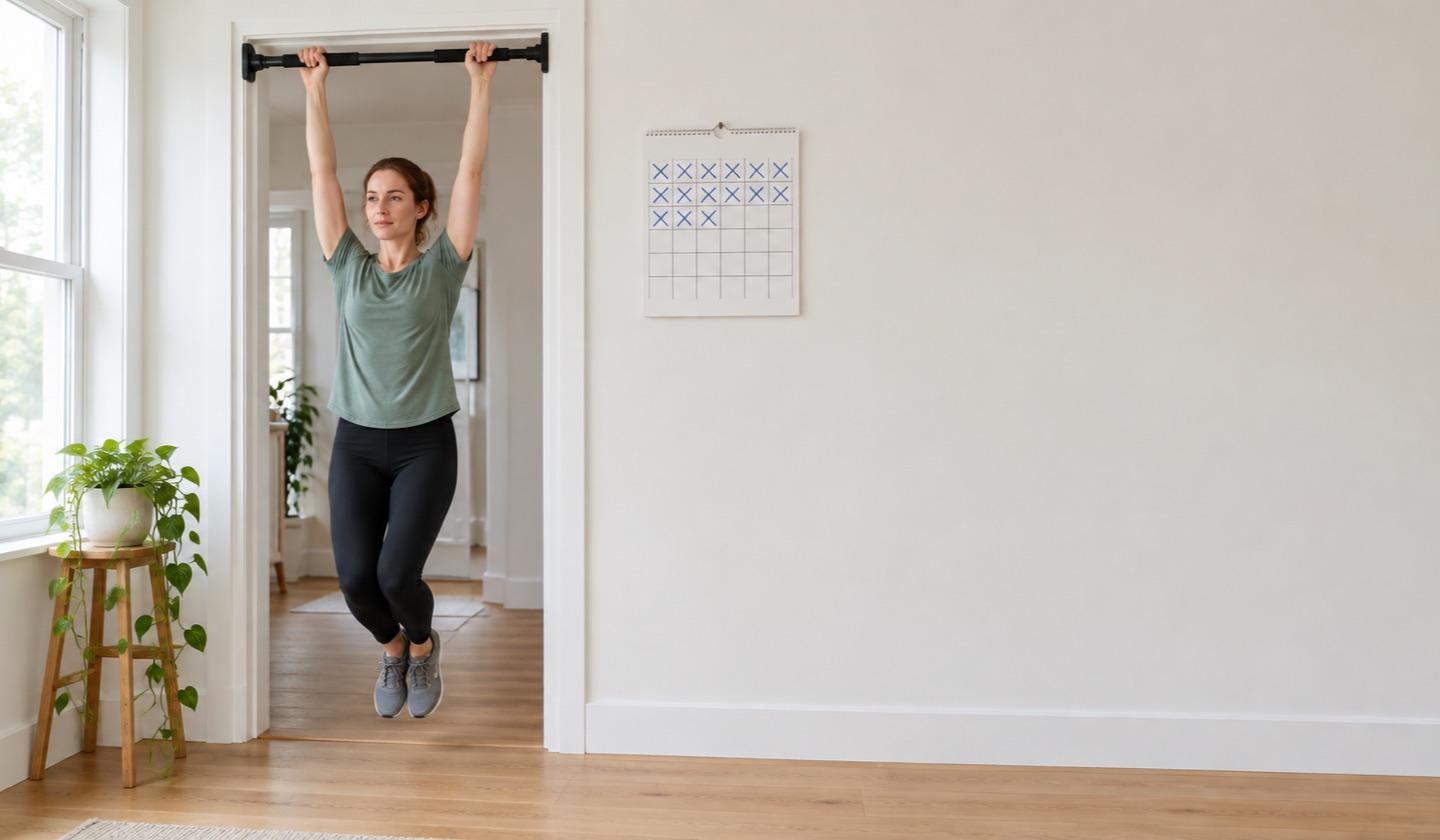
A 30-day dead hang challenge is a month of short hanging sessions that get a little longer each week. The chart below starts with a test on day one, sets every hang as a share of the time you actually held, puts a rest day between sessions so your grip can recover, and finishes with a retest on day 30. That way the same chart works for someone who holds 15 seconds and someone who holds 90.
If you have not hung from a bar before, start with how to do dead hangs at home, which covers what to hang from and how to set up safely. This post is the plan that comes after.
The 30-day dead hang challenge chart
Here is the whole month. Percentages are of your own day-one time, each training day is a set of hangs with about a minute of rest between them, and the days in between are rest days.
- Day 1: test. One controlled hang to your limit. Write the number down.
- Days 2, 4 and 6: three hangs at 50 per cent of your day-one time.
- Days 9, 11 and 13: three hangs at 60 per cent.
- Days 16, 18 and 20: three hangs at 70 per cent.
- Days 23, 25 and 27: two hangs at 75 per cent. Fewer hangs, so you go into the retest fresh.
- Day 30: retest. One controlled hang to your limit again.
- All other days: rest.
Round each target to the nearest 5 seconds, and never go below 10. If your day-one hang was under 20 seconds, keep a foot lightly on a step for the training hangs and let your arms take most of your weight.
What that looks like in seconds
| Day-one time | Week 1 (3 hangs) | Week 2 (3 hangs) | Week 3 (3 hangs) | Week 4 (2 hangs) |
|---|---|---|---|---|
| 20 seconds | 10s | 10s | 15s | 15s |
| 30 seconds | 15s | 20s | 20s | 25s |
| 60 seconds | 30s | 35s | 40s | 45s |
| 90 seconds | 45s | 55s | 65s | 70s |
Rather not do the sums? Time your day-one hang on the dead hang tracker. It shows which band your time falls in and can turn it into a free 4-week plan that sets each week’s hangs from your own starting time, the same way as the chart above.
Why this chart works the way it does
This is our own challenge format, not a protocol from a study, so here is the reasoning behind each choice.
It starts from your time, not a fixed number
A chart that tells everyone to hang for 10 seconds on day one and two minutes on day 30 is too easy for some people and out of reach for others. Testing first and training at a share of that number keeps every session hard enough to count and short enough to finish.
It stops each hang before your grip gives out
Training hangs sit between half and three-quarters of your best, so you step down while you are still in control. Physiotherapists writing about shoulder safety advise building hang time gradually and not letting yourself get too tired, because the end of a hang, when your grip is failing, is where control slips [1].
It has rest days built in
Grip work tires your hands and forearms in a way you notice the next morning. Twelve training days and sixteen rest days between the two tests is plenty of practice, and it leaves room for a busy day without falling behind.
How to do each hang
- Step up to the bar from a sturdy step rather than jumping.
- Overhand grip, about shoulder-width, thumbs wrapped around the bar.
- Arms straight, shoulders a little lifted but not completely slack [1].
- Body still, no swinging or kicking.
- Breathe steadily the whole time. Never hold your breath, which can cause a sharp rise in blood pressure [2].
- Step down while your grip is still under control. Stop straight away if a hang causes pain, or tingling or numbness in your arms or hands.
Use the same bar, grip and time of day for the two tests, so day 30 is a fair comparison with day one.
What to do when you miss a day
Do the session the next day and carry on at the same target. Do not double up and do not restart the chart. In a study of people building a new daily habit, missing a single opportunity did not meaningfully affect how the habit formed [3], which is the research version of a simple rule: the challenge that works is the one you are still doing on day 30.
Will 30 days make dead hangs a habit?
Maybe not on its own. In that same study, the median time for a new daily behaviour to become close to automatic was 66 days, with individual estimates from 18 to 254 days across the 39 participants whose data fitted the model [3]. Thirty days is long enough to see your hang time move. Keeping going after day 30 is a separate question, and three short sessions a week is easier to keep than seven.
Doing the challenge with other people
There is decent evidence for the social side. A 2023 meta-analysis of 19 studies found that people exercising as pairs, where the pair’s result depended on the weaker partner, put in more effort than people exercising alone [4]. A friends leaderboard is not that experimental setup, so treat it as a nearby finding, but for a lot of people someone else’s time on the board is what gets them to the bar on day 25. Our post on the Köhler effect goes through the research.
Frequently asked questions
Is the 30-day dead hang challenge suitable for beginners?
Yes, because every target is a share of your own day-one time and nothing goes below 10 seconds. If even that is too much, keep a foot on the step and let your arms take most of your weight. If you have shoulder instability, have dislocated a shoulder before, or have pain reaching overhead, speak to a physiotherapist or doctor before starting [1].
Should I dead hang every day for 30 days?
You do not need to. This chart trains three days a week with a rest day between sessions. Some people enjoy a short, easy hang most days as a stretch, but keep the hard training hangs to the chart days.
What is a good dead hang time at the end of 30 days?
Your own day-one time is the fairest comparison. There are no published dead hang norms by age; our post on average dead hang time by age explains what does exist and where the coaching bands come from.
What do I do after day 30?
Use your retest time as the new day one and run the chart again. If you want a change, try the same structure on a plank or a wall sit, each tested from its own starting time.
The bottom line
Test on day one, hang at half to three-quarters of that time three days a week, take the rest days, and retest on day 30. The number to beat is your own.
Time your day-one hang on the dead hang tracker to see where it sits and get a free 4-week plan built from it, and a free Just Hold account keeps every hang after that, with friends or family on the same leaderboard if you like.
This page is for educational purposes only and is not medical advice. If you have existing shoulder, elbow or back problems, or you have high blood pressure or a heart condition, speak with a qualified clinician before starting a new training routine.
- Ganderton C, Warby S. What are dead hangs? What are the shoulder pain risks and how do I do them safely? The Conversation, 21 April 2023.
- Mayo Clinic. Isometric exercises: Good for strength training?
- Lally P, van Jaarsveld CHM, Potts HWW, Wardle J. How are habits formed: Modelling habit formation in the real world. European Journal of Social Psychology. 2010;40(6):998–1009.
- Samendinger S, Hill CR, Ahn S, Feltz DL. The Köhler Motivation Gain Effect With Exercise Tasks: A Meta-Analysis. Kinesiology Review. 2023;12(3):187.